
Dilshan Madhuranga ·Follow
Karthigesu Indrapala stands among the most respected historians and archaeologists produced by Sri Lanka. His life’s work transformed the study of the island’s ancient past through meticulous research, careful interpretation of inscriptions, and decades of field exploration. Rather than relying on legends or assumptions, he dedicated himself to uncovering historical evidence hidden in stone inscriptions, archaeological sites, and forgotten settlements. His scholarship earned international recognition and established him as one of the foremost authorities on the early history of Sri Lanka and its Tamil communities.
Born on 22 October 1938 in Vaddukoddai in northern Ceylon, Karthigesu Indrapala grew up in a family that valued education and learning. His parents encouraged intellectual curiosity from an early age, allowing him to develop a deep interest in history and culture. The landscapes of northern Sri Lanka, rich with ancient temples, inscriptions, and historical traditions, sparked his imagination. Long before he became a professional historian, he was fascinated by questions about how earlier generations had lived and how their stories could be reconstructed through evidence.
He received his early education at Jaffna College, one of the country’s distinguished educational institutions. There he demonstrated exceptional academic ability and a remarkable enthusiasm for the humanities. Teachers quickly recognized his talent for historical analysis and encouraged him to pursue higher education. His years at school laid the foundation for a career that would eventually influence generations of students and researchers.
In 1956 he entered the University of Ceylon at Peradeniya to study ancient history. University life opened new intellectual horizons and introduced him to the disciplines of archaeology, epigraphy, and historical research. He excelled throughout his studies and graduated with first class honours in ancient history, an achievement that reflected both his determination and outstanding academic ability. Even as a young scholar, he displayed an unusual commitment to examining historical sources with precision and care.
Soon after completing his degree, Indrapala joined the Department of History at the University of Ceylon in 1960. As a young lecturer he combined teaching with research, inspiring students while pursuing questions that had received little scholarly attention. He became especially interested in epigraphy, the study of ancient inscriptions carved on stone, metal, and other durable materials. These inscriptions preserved valuable information about rulers, settlements, religion, trade, and everyday life. Indrapala understood that each inscription represented an authentic voice from the past, capable of correcting misconceptions and enriching historical knowledge.
His passion for research eventually took him to London, where he pursued doctoral studies. His doctoral thesis examined Dravidian settlements in Ceylon and the beginnings of the Jaffna Kingdom. The research demanded years of patient investigation, critical analysis, and comparison of archaeological and literary sources. Completing his PhD strengthened his reputation as an emerging authority on the early history of Sri Lanka and prepared him for even greater scholarly contributions.
After returning to Sri Lanka, he resumed his research with renewed energy. He underwent specialised training in epigraphy in Mysore, India, refining the technical skills needed to read and interpret ancient inscriptions accurately. Equipped with this expertise, he embarked on extensive fieldwork across the Northern, North Central, and Eastern Provinces. Between 1966 and 1974 he travelled through forests, remote villages, and archaeological sites in search of inscriptions and ancient temples that had remained unnoticed for generations. These expeditions were physically demanding and often required perseverance under difficult conditions, yet they produced discoveries that significantly expanded historical knowledge.
Many of the inscriptions he documented provided fresh evidence about ancient settlements, cultural interactions, and religious life in Sri Lanka. His work demonstrated the importance of combining archaeological evidence with written records instead of relying solely on traditional narratives. This careful approach earned respect among historians both in Sri Lanka and abroad.
In 1974 Indrapala accepted a new responsibility when he became Dean of the Faculty of Humanities at the Jaffna campus of the University of Sri Lanka. During this period he played an important role in developing higher education in the north of the country. His leadership encouraged research, strengthened academic standards, and created opportunities for students to engage directly with Sri Lanka’s archaeological heritage.
Two years later he served as a visiting professor at the University of Tokyo, reflecting the growing international recognition of his scholarship. Exposure to scholars from different countries broadened his academic perspective while allowing him to share Sri Lanka’s historical heritage with the wider world.
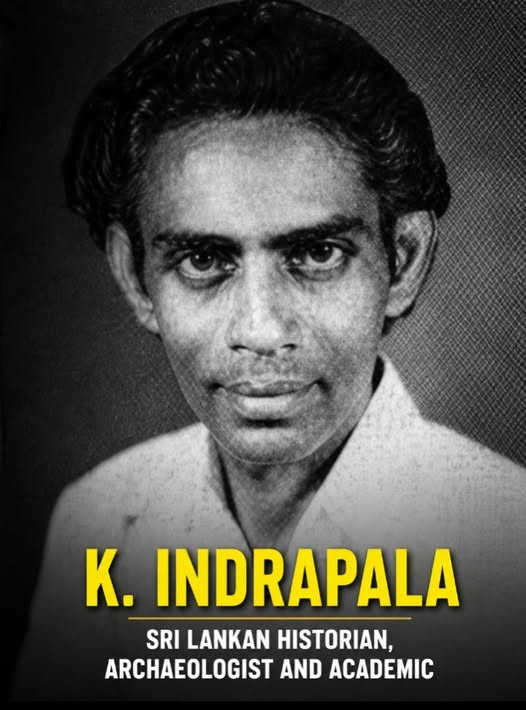
When the University of Jaffna was established, Indrapala became its Foundation Professor of History. This was one of the defining chapters of his career. He introduced courses in archaeology and epigraphy, helping to create a new generation of researchers trained in scientific historical methods. He also established the university’s archaeological museum, ensuring that important artefacts could be preserved for education and future study.
His archaeological excavations on the Jaffna Peninsula became another landmark achievement. Among his most significant discoveries was the ancient burial site associated with the Anaikoddai seal, a finding that attracted considerable scholarly attention. These excavations added valuable evidence to the understanding of early societies in northern Sri Lanka and demonstrated the importance of systematic archaeological investigation.
From December 1982 until July 1984 he served as Dean of the Faculty of Arts at the University of Jaffna. His administration balanced academic leadership with continued research, even during a period of significant challenges. Colleagues remembered him as a calm, disciplined scholar who valued careful reasoning over speculation and encouraged students to question evidence critically.
In 1984 he joined the newly established Tamil University in Thanjavur, India, where he continued teaching and research. His expertise contributed to the growth of historical and archaeological studies there as well. Later he settled in Australia, remaining active as a researcher and author while continuing to write on South Asian history and archaeology.
Throughout his long career Indrapala published influential books that reflected decades of scholarship. Among his most widely recognised works are The Evolution of an Ethnic Identity, The Tamils of Sri Lanka C. 300 BCE to C. 1200 CE, Ancient Tamil Nadu, Glimpses of the Past, and Ancient Sri Lanka, Glimpses of the Past. These publications brought together years of research and continue to serve as important references for students, historians, and readers interested in the region’s ancient history.
Beyond his titles and discoveries, Karthigesu Indrapala’s greatest legacy lies in his commitment to evidence based scholarship. He demonstrated that history is not merely a collection of stories but a discipline built upon careful observation, critical analysis, and respect for historical sources. His work encouraged scholars to examine inscriptions, archaeological remains, and material evidence with patience and intellectual honesty. Through decades of teaching, research, excavation, and writing, he helped illuminate chapters of Sri Lanka’s past that might otherwise have remained hidden. His remarkable career continues to inspire historians, archaeologists, and students who believe that understanding the past is essential for understanding the present.
Information source. Wikipedia and published biographical references.
Photo credit. Wikimedia Commons, University of Jaffna archives where applicable.
 If you enjoy reading please follow my channel.
I will continue bringing you more inspiring biographies, fascinating life stories, and lesser known stories around the world.
Follow the page and stay connected for the next story.
#KIndrapala#KarthigesuIndrapala#SriLanka#Historian#Archaeology#Epigraphy#Jaffna#UniversityOfJaffna#AncientHistory#TamilHistory#Biography#HistoryLovers#SriLankanScholars#Education#Archaeologist
See less

Leave a Reply
You must be logged in to post a comment.