
Sri Lanka’s Article 9: When Constitutional Ideals Clash with Political Reality
Veluppillai Thangavelu
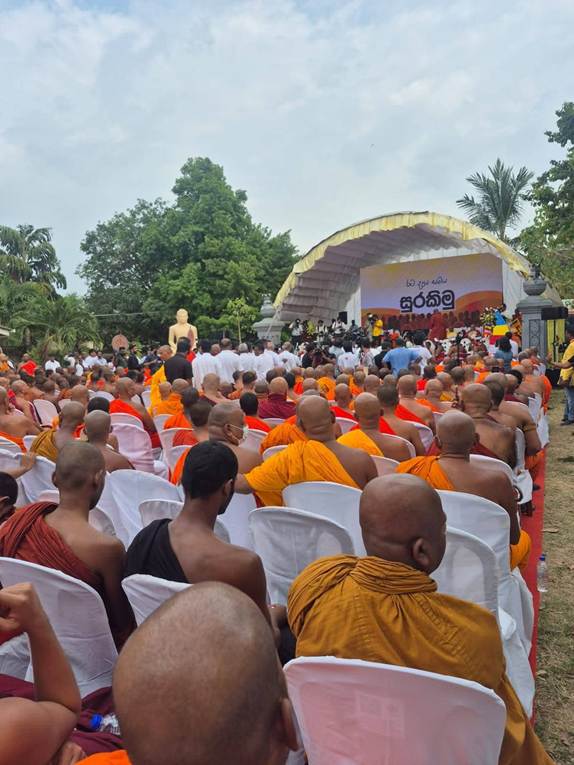
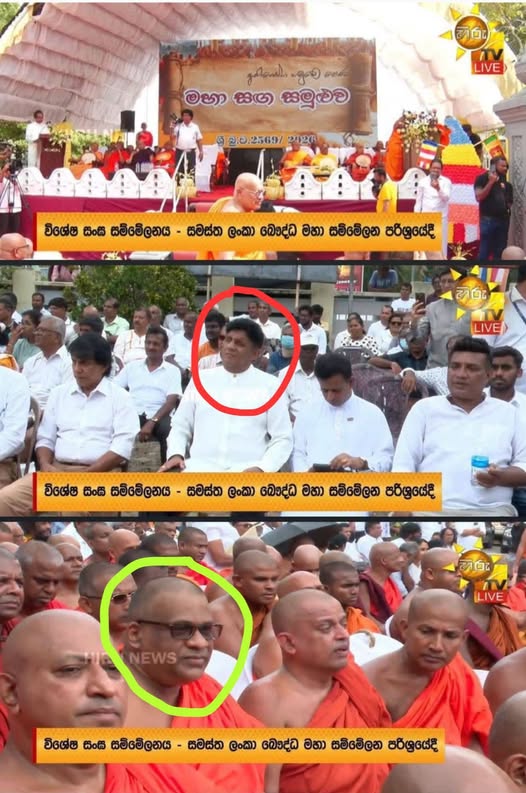
Last week, a “Maha Sangha Conference” was held at the premises of the All-Ceylon Buddhist Congress in Colombo. Hundreds of monks from many parts of the country participated. According to the conference organizers, the aim was to confront the threats facing the Buddhist Sasana, Buddhist monks, and Buddhist culture.
“In the country, there is no problem between communities or religions. Some openly advance ethnic and religious extremist views. Among them, the President and Prime Minister take the lead. Initially, it was announced that thousands of monks would participate. Later, this number was reduced to 3,000. In the end, the number of monks who participated hovered around 300.
Buddhist monk Kotapitiye Rahula Thero stated that President Anura Kumar Dissanayake and Prime Minister Harini Amarassuriya must apologize for making statements against Buddhism. He mentioned this while participating and speaking at the All-Ceylon Buddhist Maha Sangha Conference. He said:
“Tissa Maha Vihara is a place of historical significance. Monks go there to participate in religious observances. However, the President claims that monks go to Jaffna to spread Buddhist renunciation. The Constitution gives foremost place to Buddhism. We do not gather to overthrow or topple the government. The President and Prime Minister have made statements that disrespect Buddhism. In short, as the conference organizers have said, there is now a sense that the Buddhist Sasana and Buddhist culture face multiple threats. Therefore, the President and Prime Minister must apologize. We gather to emphasize that the government should proceed on the correct path. The social status of Buddhism must be protected, the respect and authority of monks preserved, and the cultural identity safeguarded.”
Historically, Sri Lanka has been a Buddhist country. There are 42,122 registered Buddhist monks, 12,235 registered Buddhist temples (viharas), and additionally 743 dasasil matha monasteries and 38 shrines. The population of Sri Lanka is 22 million, of which 15 million (68%) are Buddhist Sinhalese. The moral expectation is that these monks devote themselves full-time to the preservation and dissemination of the Buddha’s teachings, rather than to direct political mobilization.
Maha Sanga Conferences occasionally take place. In August 2024, it is said that a conference was organized by Galagoda Gnanasara Thero. It is not clear whether it actually took place. The major Buddhist chapters of the country, Asgiriya-Malwatte, did not directly support this conference, but they did not prevent monks from participating.
In 2010, during the presidency of Mahinda Rajapaksa, Army Commander Sarath Fonseka was removed from office, arrested, and imprisoned. In protest, the Asgiriya-Malwatte Buddhist chapters raised protest flags. On February 18, 2010, Maha Nayaka Theros called for a historic “Sangha Sabha” (monks’ conference) in Kandy. The Rajapaksa government violently suppressed it.
There were threats of bomb attacks on monks attending the conference, leading to its indefinite postponement. Pro-government groups threatened to split around 500 viharas from the main Buddhist chapters to form a new chapter centered in southern Sri Lanka. Senior ministers pressured Maha Nayaka Theros not to interfere in political matters and to abandon the conference. Monks supporting Fonseka in Colombo were brutally attacked and arrested by police in April 2010. Pro-government monks publicly denounced those opposing Fonseka, labelling them as “supporters of terrorism.”
Because of these planned threats and suppression, the massive opposition by Buddhist chapters against the Rajapaksa government was successfully crushed. Therefore, contrary to what many believe, the Asgiriya, Malwatte, Amarapura, and Ramana Buddhist chapters are not all-powerful authorities capable of controlling governments at will.
It is true that Presidents and Prime Ministers have gone to prostrate at the feet of chief Buddhist prelates. President Anura Kumar Dissanayake is no exception. Since taking office, he has gone to Kandy over ten times to pay respects to Buddhist Nayakas.
However, in Sri Lanka, Buddhism is not only a spiritual tradition but also a key part of national identity. Historically, the Buddhist Sangha has influenced social order, cultural preservation, and political thinking. Many political leaders have sought the support of Buddhist monks in various periods. Because Sinhalese Buddhist national sentiment has played an important role in political movements, the question of protecting Buddhism generally mobilizes political support.
The organizers of the conference claimed that the Buddhist Sasana and Buddhist culture face multiple threats that have arisen. On this basis, they emphasized:
- The social status of Buddhism must be protected
- The respect and authority of monks must be safeguarded
- Cultural identity must be preserved without erosion
Although politicians were invited, the conference saw the presence of SJB leader Sajith Premadasa and former Navy Rear Admiral Sarath Weerasekara. In recent months, Sajith Premadasa has increasingly positioned himself as a fervent defender of Buddhism. Since Buddhism has priority and protection in the political sphere, he demanded that the government must consult Maha Nayaka Theros before taking any action.
He said: “The government acts in ways that disrespect Maha Nayaka Theros and Buddhist monks, who act as the guardians of the Buddhist Sasana. All Buddhist people must strongly oppose government actions against the Buddhist Sasana.” He also added tongue-in-cheek that a National Reconciliation Council be established, including Buddhist religious leaders, other religious leaders, and political party leaders, emphasizing the importance of reconciliation between religions and communities while protecting Buddhism.
At this conference, Muruththettuwe Ananda Thero, Galagoda Aththe Gnanasara Thero, Balangoda Kassapa Thero, and Bengamuwa Nalaka Thero participated. All of them considered the government to have adopted an anti-Buddhist stance. Muruththettuwe Anand Thero, the chief organiser, accused the current government of targeting Buddhist monks and urged President Anura Kumar Dissanayake to control politicians who criticise monks. This accusation can be seen as a symptom of the erosion of trust between Buddhist leadership and the political authority.
The accusations against the government include:
Rumours that ministers and the Buddhist Ministry would be abolished circulated on social media. The government denied this. Prof. Himduma Sunil Senevi, Minister of Buddha Sasana, Religious, and Cultural Affairs, clarified that “Only policy-based changes have been made. The ministry has not been abolished.”
Minister Sunil Watagala and others have rejected these allegations, stating that the National People’s Power is the true guardian of Buddhism. At the same time, the government has pointed out that under Article 9 of the Constitution, it is duty-bound to protect and foster Buddhism.
In reality, the target of certain Buddhist monks is no one else. It is none other than President Anura Kumara Dissanayake himself. Last month, in connection with the Pongal festival, Dissanayake visited Jaffna. At that time, a protest was taking place against the Tissa Maha Vihara in Thaiyiddy, which had been constructed unlawfully in private land occupied by the Sri Lanka Army. Keeping that in mind, President Dissanayake spoke thus:
“…they come to Jaffna after passing the … to perform the Poya. What is there is not the Poya, but hatred…” — meaning that some people were using religious pilgrimages not purely for religious worship but in ways that reflected racial or political agendas, not genuine devotion.
“…When they come to Jaffna, they say they are coming to observe the Buddhist Poya day. But what is there is not Poya — it is hatred…”
The meaning of this is that some people are not coming entirely for spiritual purposes. They are using pilgrimages in certain places for racial, political, and symbolic purposes. It is not true devotion, but actions driven by a cultural/political agenda.
At the same time, President Dissanayake dubbed the Tamils protesting against the unauthorised Thaiyiddy Tissa Maha Vihara as racists.
Many consider that the Maha Sangha conference convened in Colombo was held at the wrong time. It has been only one and a half years since the National People’s Power government came to power. This is a short period. The people of the country are now expressing greater support for the present National People’s Power government than before.
According to a recent opinion poll, there is growing confidence among the public about Sri Lanka’s future. The government has received strong support, and economic confidence has risen significantly. These findings were revealed in the “Mood of the Nation” survey conducted by Verité Research. The polling partner for this study was Vanguard Survey (Pvt) Ltd.
In early February 2025, support for the government stood at 62%. It has now increased to 65%. For the first time in the four-year history of the survey, those who rated the current economic situation as “good” or “very good” outnumbered those who described it as “bad.” Those who said the economy is “improving” were 64% (an increase from 55% last year), while the view that it is “worsening” has not changed significantly.
This means that people have begun to trust the direction of the administration. The perception that the economy is improving may also encourage spending and investment. After the crises of the past few years, public sentiment is shifting from anxiety to cautious optimism. However, for this confidence to be sustained, real progress is necessary in areas such as cost of living, employment opportunities, and income stability.
The influence of Buddhist monks is not as great as they imagine. As evidence, when a Sangha conference was convened in Kandy to protest the arrest and imprisonment of the Army Commander, the then Rajapaksa government crushed it with overwhelming force.
Nevertheless, a majority of Buddhist monks genuinely believe that they stand above the law. Although Buddhism has not been declared the state religion, it has been granted a unique constitutional status.
Article 9 of the Constitution states that Buddhism shall be given the foremost place and that it is the duty of the State to protect and foster the Buddha Sasana. This Article undermines democratic principles such as the Rule of Law, Equality before the law, and inclusive governance — values associated with democracy and secularism. When a country is divided along ethnic and religious lines, economic development becomes an uphill task. Without structural reform, the country risks falling into another cycle of failure.
Visiting Managing Director of the International Monetary Fund (IMF), Kristalina Georgieva, stated that with the current Government committed to good governance and anti-corruption reforms, Sri Lanka now has a unique opportunity to accelerate development and achieve sustained economic progress. She said that Sri Lanka has faced multiple shocks, including the Northern conflict, the tsunami, terror attacks, the pandemic and governance challenges, which have constrained long-term growth.
Leave a Reply
You must be logged in to post a comment.