
100 years after SWRD Bandaranaike’s clarion call for federalism
31 Jan 2026 – 1377
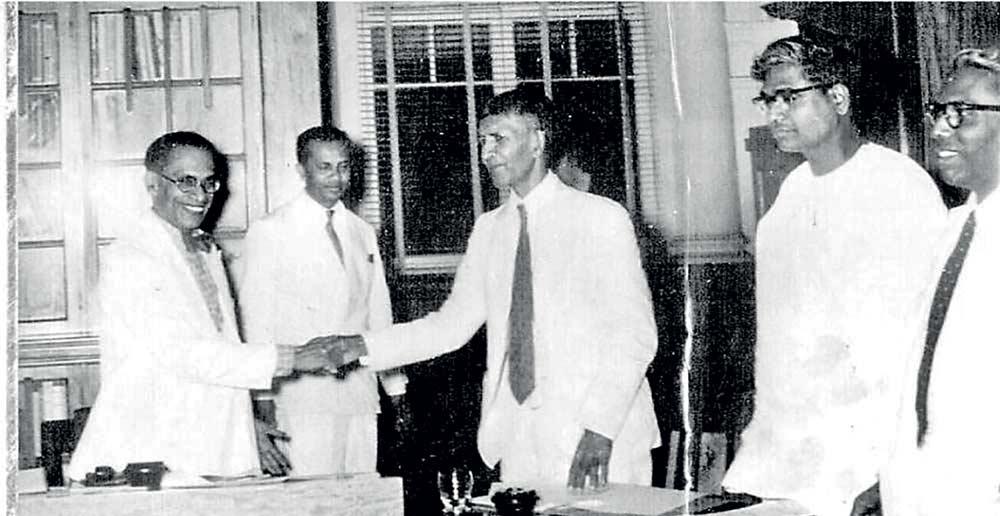
The agreement signed by S.W.R.D. Bandaranaike and S.J.V. Chelvanayagam’s meeting on 26 July 1957 was a significant event in the political history of post-independence Sri Lanka
 Dr Rohan Edrisingha in his illuminating essay ‘Federalism: myths and realities’ makes the following observation – “ It is significant to note that long before Tamil political leaders advocated federalism, the young S.W.R.D. Bandaranaike in the mid 1920’s and the Kandyan Sinhalese representatives before the Donoughmore Commission in the late 1920’s were advocates of a federal Sri Lanka.
The Kandyan Sinhalese proposed a federal Ceylon with three provinces, including a province for the North-East. In fact, it is possible to argue that it was the Kandyan Sinhalese and not the Ceylon Tamils who were not only the champions of a federal Ceylon but also the merger of the North and the East. The Kandyan Sinhalese, in fact, viewed themselves as a nation, and many of the documents of the organisations they established to advance their cause used language and arguments similar to those of Tamil nationalists and Tamil political groups in the more recent past. They were concerned about the influx of low-country Sinhalese into the Kandyan region”.
It could be seen, therefore, that federalism was first proposed by S.W.R.D. Bandaranaike, the greatest intellectual among Sinhala political leaders of that era, advocated some form of federalism as the only solution as far back as 1926. Kandyan Sinhala leaders recommended a federal arrangement of two units for low and up-country Sinhalese and one unit comprising the North–East for Tamils in 1927.
Ironically, the Sri Lankan Tamils rejected federalism when recommended by the Sinhalese. If Sri Lankan Tamil political leaders had availed themselves of the opportunity and demanded that the British grant federalism for the Tamils of the North and East, there was every chance that the request might have been acceded to. The Kandyan Sinhala and Sri Lankan Tamil political leaders could have pressurised the low-country Sinhala leaders in a political pincer. Yet this did not happen.
The Sri Lankan Tamil political leaders did not demand federalism or even a separate state while the British were ruling. Instead, these demands were raised by Tamil leaders only after the British left our shores.
The main Sri Lankan Tamil party at the time of Independence from the British was the All-Ceylon Tamil Congress. G.G. Ponnambalam Snr. was the leader of the Tamil Congress then. His Deputy was S.J.V. Chelvanayagam. GG, as he was generally known, was seen as a pragmatic politician by his supporters. After full independence dawned, Ponnambalam opted to join the D.S. Senanayake Cabinet and became Industries and Fisheries Minister.
But some of his deputies like Chelvanayagam, C. Vanniyasingham, E.M.V. Naganathan and V. Navaratnam rebelled against Ponnambalam.
ITAK/FP
They broke away and formed a new party in 1949. It was called the Ilankai Thamil Arasu Katchi (ITAK) in Tamil. Its English translation should have been Ceylon Tamil State Party, but instead it was called Federal Party (FP). The new party wanted an autonomous Tamil State comprising the Tamil-dominated Northern and the Tamil-majority Eastern Provinces within a united Ceylon, as Sri Lanka was known then.
The birth of ITAK was a watershed in Ceylon politics as it was the first party to articulate the federal idea as its main ideology and goal after Independence. The ITAK/FP wanted federalism to protect Tamil interests and achieve ethnic harmony. Unfortunately, federalism as promoted by the ITAK was embroiled in controversy. It was misrepresented, misunderstood and therefore much maligned and much hated. Despite substantial sections of the majority community treating Federalism as a ‘F-Word’ , the ITAK continues to espouse a political settlement based on the federal idea still. The Sri Lankan Tamil quest for equitable power sharing continues.
‘Federal centenary’
One hundred years have passed since S.W.R.D. Bandaranaike issued his clarion call for Federalism in Sri Lanka. 2026 is therefore the centenary year of S.W.R.D. Bandaranaike’s federal proposal. The ITAK which is the premier political party of the Sri Lankan Tamils is planning to mark the ‘federal centenary’ by launching a public campaign to promote an appropriate power-sharing model. ITAK General Secretary and former Jaffna District MP, Mathiaparanan Abraham Sumanthiran, is the moving force behind this project.
Speaking to this column, M.A. Sumanthiran said, “This year marks 100 years since SWRD introduced federalism to our country. He wrote six letters to The Morning Leader newspaper in 1926 and travelled to Jaffna in July 1926 to deliver the “Jaffna Lecture” to convince the Tamils that a federal government was the most appropriate system for Ceylon. I intend to start a forum to explore power-sharing models and promote the appropriate model that makes power – sharing most meaningful in today’s context. I’ve spoken to a number of persons in the South who are willing to join me in this exercise.”
S.W.R.D. Bandaranaike is no more, but the memory of his clarion call for federalism in 1926 seems to be the inspiration behind the project of seeking an acceptable power-sharing arrangement a hundred years later. As mentioned earlier, SWRD was the first person of eminence who proposed federalism in Ceylon/Sri Lanka during colonial rule. He also envisaged the setting up of Provincial Councils.
It is against this backdrop, therefore, that this column focuses this week on Bandaranaike and his espousal of federalism a hundred years ago. I have written about S.W.R.D. Bandaranaike, I will rely on some of my earlier writings for this article.
Solomon West Ridgeway Dias Bandaranaike, known as S.W.R.D. Bandaranaike was the fourth Prime Minister of Independent Sri Lanka, known then as Ceylon. SWRD, who was born on 8 January 1899, died due to an assassination on 26 September 1959.
Young Bandaranaike returned home in 1925 after pursuing a brilliant academic career at Christ Church College, Oxford. Like many young idealists from countries under colonial bondage, SWRD too came back with a zealous sense of mission to serve his country and people.
‘Progressive National Party’
While being a member of the Ceylon National Congress, Bandaranaike also founded a political party known as the ‘Progressive National Party’ to achieve the goal of political self-government. S.W.R.D. Bandaranaike became the Leader of the Progressive National Party while C. Ponnambalam of the Jaffna Youth Congress was the Party Secretary.
The Oxford-returned SWRD was of the view then that Ceylon should become a federation. The Progressive National Party, in its Constitution, detailed an outline of the federal system Bandaranaike had in mind. While noting that the three main groups in the country were the low-country Sinhalese, up-country Sinhalese and the Tamils, the party Constitution wanted the federal system to be based on the nine provinces, with each having complete autonomy. There was to be a bicameral legislature consisting of a ‘House of Commons’ and ‘House of Senators’.
Bandaranaike’s proposal for a federal Constitution was supported by all members of the Progressive National Party except one. The solitary dissident was the scholar James T. Rutnam, who was Bandaranaike’s close friend and associate. Incidentally, James Rutnam was the father ofthe well-known filmmaker Chandran Rutnam.
‘Ceylon Morning Leader’
S.W.R.D. Bandaranaike wrote a series of six articles for the ‘Ceylon Morning Leader’ articulating his vision for federalism. The preliminary article appeared on 19 May 1926. The following excerpt consists of the introductory paragraphs from the preliminary article: “At a time when the desire for self-government appears to be growing ever stronger, and successive instalments of ‘reforms’ seem to bring that goal almost within sight, two problems of vital importance arise, which require careful and earnest thought. The first is the question of Ceylon’s external status, that is, what is her position as a nation in relation to other nations.
“The second is her internal status, the adoption of a form of government which would meet the just requirements of the different sections of her inhabitants. No effort has yet been made seriously to consider these problems, nor indeed in some quarters is it realised that the problem exists at all. There is the usual vague thinking, there are the usual generalisations, to which politicians are only too liable, the catch-words are the bane of politicians all over the world in Ceylon we find in constant use, such phrases as ‘co-operation,’ ‘self-government,’ ‘cabinet-government,’ without any clear understanding of either what they really involve or whether and to what extent, they are applicable to our own particular difficulties. The writer believes the true solution to the problem mentioned is contained in the federal system and these articles are intended as a general introduction to the subject.”
S.W.R.D. Bandaranaike’s advocacy of federalism did not create a major political splash at that time; it only caused ripples. The federal idea did not evoke a communal or Sinhala backlash then. The strongest critique was not from a Sinhalese but from a Tamil.
Educationist and scholar James T. Rutnam wrote articles in ‘Ceylon Morning Leader’ arguing against the views of his friend S.W.R.D. Bandaranaike. James Rutnam was for a unitary Constitution. He opposed a federal Constitution saying it would cause disunity among the people. It is, however, noteworthy that James Rutnam revised his opinion of 1926 and advocated federalism thirty years later, after 1956.
SWRD’s Jaffna lecture
Federalism, when suggested by SWRD in 1926, was also opposed by the Jaffna Students’ Congress (later renamed as the Jaffna Youth Congress) also. Bandaranaike was invited by the Jaffna Youth Congress to deliver a lecture to a large audience in Jaffna. SWRD travelled up to Jaffna and spoke on federalism at a meeting held on 26 July 1926.
The well-attended meeting was presided over by Dr Issac Thambyayah. S.W.R.D. Bandaranaike spoke eloquently on the topic ‘Federation as the only solution to our political problems’. SWRD argued that regional autonomy was the ideal way to manage communal differences.
The Tamil audience was neither impressed nor enamoured by the federalism pitch. Bandaranaike was subjected to a barrage of questions challenging federalism as a valid form of government for the island. He answered with great erudition but there were few takers for federalism among Tamils in Jaffna then.
Nevertheless, S.W.R.D. Bandaranaike stood firm, saying, “A thousand and one objections could be raised against the system, but when the objections are dissipated, I am convinced that some form of federal government will be the only solution.”
‘Sinhala Maha Sabha’
With the advent in 1931 of the Donoughmore Constitution resulting in the introduction of universal franchise and territorial representation, Bandaranaike’s political vision underwent a transformation. He now felt that the largest community, the Sinhalese, had to be ‘united’ to bring about national unity. Hence, along with some like-minded souls, Bandaranaike formed the ‘Sinhala Maha Sabha’ in 1936.
Bandaranaike also contested the Veyangoda constituency at the State Council elections of 1931 and 1936. In both instances, he was elected unopposed. The ‘pan-Sinhala’ board of ministers set up in 1936 saw Bandaranaike become Local Government Minister.
Subsequently, SWRD moved away from espousing federalism to encouraging decentralisation. It must be noted that there was really no antipathy towards federalism then. It was more apathy and disinterest. SWRD himself had great political ambition and sought to build up his base through the Sinhala Maha Sabha and through enhancing the Local Government system. So he wanted to revamp the Local Government system and provide greater autonomy through decentralisation.
Provincial Councils
SWRD began envisaging the province as the unit of greater local authority. He wanted to set up Provincial Councils. The Local Government Ministry’s Executive Committee released a report advocating for more powers to these proposed councils. In 1940, R.S.S. Gunawardena introduced a motion in the State Council proposing the setting up of Provincial Councils. The State Council approved it, but for some inexplicable reason SWRD did not proceed further and present a Bill in the State Council during its tenure.
Bandaranaike later joined the United National Party (UNP) with his Sinhala Maha Sabha. He was appointed the Local Government Minister in Independent Ceylon’s first Cabinet under D.S. Senanayake. It is said that SWRD tried to revive his Provincial Council formulation again as a means to bringthe government closer to the people. But his Cabinet colleagues, enjoying power as full-fledged ministers, were reluctant to dilute or reduce their newly-gained authority. So SWRD could not go through with his plans.
This was indeed a great pity because the envisaged Provincial Councils could have been set up without much problem then, as the ethnic dimension was not prevalent then as it was later. In 1951, Bandaranaike crossed over to the opposition and founded the Sri Lanka Freedom Party (SLFP).
The historic 1956 General Elections resulted in a deep polarisation between the Sinhala and Tamil communities. While the Mahajana Eksath Peramuna (MEP) joint front headed by S.W.R.D. Bandaranaike swept the polls in the south, the Federal Party led by S.J.V. Chelvanayagam won six out of nine seats in the north and four out of seven in the east.
One of the first acts by the new government was the enshrining of Sinhala as the sole Official Language of the country. Anti-Tamil violence erupted in several parts of the country. With increasing communal tension, the country seemed to be heading for a bloodbath.
Regional Councils
SWRD who was arguably the most intellectual of all Sri Lanka’s prime ministers, realised that the situation had to be checked and reversed. He understood that the Tamils had genuine grievances that had to be redressed. Bandaranaike, the man who proposed federalism for Sri Lanka in 1926, knew that effective power sharing was the only solution. Instead of federalism, he now wanted extensive decentralisation through the setting up of Regional Councils.
It is widely believed that the Regional Councils scheme was introduced by Bandaranaike as a result of the B-C pact. Actually, a draft Bill for Regional Councils was published on 17 May 1957. The B-C pact came later in July. After presenting the Regional Councils Bill, SWRD wanted to arrive at an understanding with the Tamil leaders and modify it further.
Govt.-FP Talks
A meeting between Premier S.W.R.D. Bandaranaike and ITAK/FP leader Samuel James Veluppillai Chelvanayagam were mooted. It was done on the personal initiative of Prime Minister Bandaranaike himself. The first meeting was held on 22 June 1957 at the Premier’s residence in Horagolla.
The FP delegation led by Chelvanayagam pointed out that SWRD’s own viewpoint in the ’20s that federalism was the ideal solution had been a source of inspiration for the party in demanding federalism. The FP approach was to encourage Bandaranaike to view matters through a federal prism by acknowledging his historic role of being the pioneering proponent of federalism in the country.
But this was more than 30 years ago. The situation had changed. The negative, vitriolic propaganda against federalism had distorted the meaning of the concept in the general Sinhala perception. Although the intellectual giant Bandaranaike knew what federalism was all about, he was not prepared to accept or associate with federalism now.
So SWRD who had formerly “flirted” with federalism, replied by saying that though he espoused federalism then, he had subsequently changed his mind. Besides, he had no mandate for introducing federalism. “Could not the FP think of an alternative solution short of federalism that would redress Tamil grievances and address aspirations?” Bandaranaike queried.
SWRD then suggested that the ITAK should come up with alternative proposals envisaging ‘massive decentralisation’ but not ‘federal autonomy.’ The ITAK/FP agreed and departed. Thereafter, a series of Government-FP discussions were held. Finally, a draft agreement was formulated.
The agreement signed by S.W.R.D. Bandaranaike and S.J.V. Chelvanayagam on 26 July 1957 was a significant event in the political history of post-independence Sri Lanka. The Prime Minister of the day and the Leader of the biggest Tamil political party had come to an understanding, which if implemented, may have helped contain the ethnic conflict at its nascent stages.
Banda -Chelva Pact
The agreement, known generally as the “Banda-Chelva Pact”, was never allowed to work because of political opposition in the south. The opposition came from hardliners among the Sinhala Buddhist clergy and laity as well as hawkish elements among both the Government and Opposition.
200 Buddhist monks and 300 others squatted outside Bandaranaike’s house on 9 April 1958, demanding the pact be revoked. Finally, SWRD caved in and repudiated the pact unilaterally, tearing up a copy to symbolise it.
This then is the story of S.W.R.D. Bandaranaike, who started out as the pioneering proponent of federalism and later transformed into an advocate of decentralisation in the form of Provincial and Regional Councils. This transition from propounding federalism to espousing decentralisation is strikingly illustrated by the essence and nature of the Regional Councils envisaged by the pact Bandaranaike signed with Chelvanayagam.
Salient factor
The political evolution and transformation of Bandaranaike is, by itself, a fascinating study. Despite the changes in his political outlook, an underlying thread remaining constant in Bandaranaike’s political thinking was that some form of decentralised power sharing was imperative for the essential well-being of this resplendent island and her people. This is a salient factor that cannot be dismissed, ignored, overlooked or glossed over in any Constitution-making or Constitutional reform exercise.
Leave a Reply
You must be logged in to post a comment.