
D.B.S. Jeyaraj: A Moral Compass for Tamil Journalism
on 05/18/2026
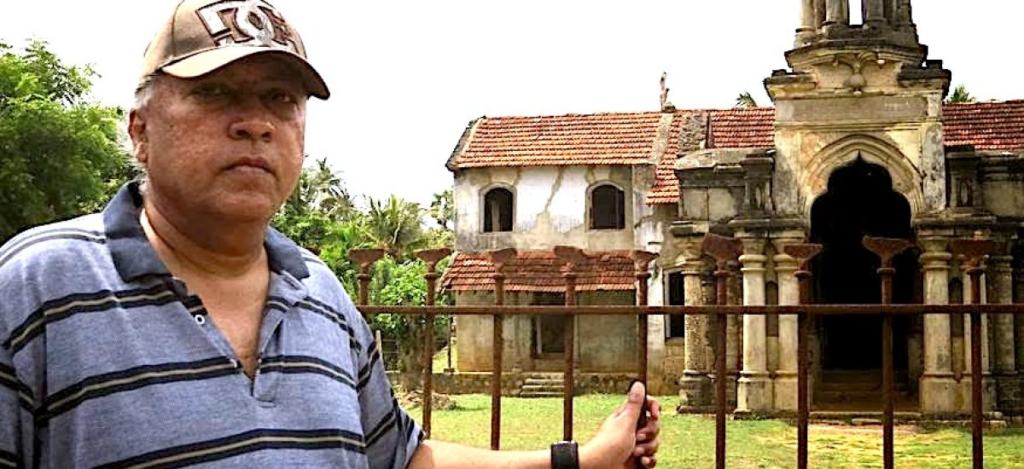
Photo courtesy of Sri Lanka Guardian
It is with tremendous sadness that I write about the passing of D.B.S. Jeyaraj. He was a journalist, a chronicler and, for those of us who found our way to the Tamil cause through his words, something far more personal: a moral framework.
As a young teenager who was born and raised in Canada, it was Jeyaraj’s writings which first introduced me to the works of constitutional scholar Dr. Neelan Tiruchelvam. His writings significantly influenced and shaped my views on the ethnic conflict and I say without hesitation that if there was no Jeyaraj, I would have never made a documentary on Dr. Tiruchelvam. His influence on my thinking was not incidental. It was foundational.
Jeyaraj’s writings would go on to be cited in human rights reports by many organizations including Human Rights Watch and Amnesty International. I was fortunate to correspond with him on multiple occasions and to tell him directly how much he meant to me. He was the first Tamil journalist I knew who had the moral courage and conviction to expose the atrocities committed by his own community. As a result, he provided me with a model to emulate in my own writings and political activism. That courage came at an extraordinary personal cost.
To understand Jeyaraj as a journalist, one must understand what he lived through as a Tamil. The anti-Tamil pogrom of July 1983 was the crucible in which his journalism was forged. When the violence erupted, Jeyaraj was on assignment in Mannar covering a Tamil United Liberation Front (TULF) party convention, separated from his family and frantic with anxiety about their fate. His family in Ratmalana, which included his parents, brother and sisters, were forced to flee their home and hide in a marsh behind their house, crouching among water monitors and snakes while a mob led by the son of a UNP municipal councillor came looking for them. His father and brother were later caught up in the violence on the notorious Tiger Friday of July 29, each narrowly escaping with their lives through a combination of quick thinking and extraordinary luck. His father, surrounded by a mob that suspected his ethnicity, survived by speaking flawless Sinhala and appealing to his attackers’ humanity. His mother and sisters were eventually relocated to Jaffna and the family home in Ratmalana was abandoned permanently.
Jeyaraj returned to Colombo on August 4, 1983, the day the parliament passed the 6th Amendment disavowing separatism. He went straight to the office and began writing under his own byline. He slept on editorial desks, used newspaper files as pillows and ate at the restaurants near the office. It was, as he wrote, his way of coping with what had happened. It was also something more than that; it was a declaration of intent. A Tamil journalist whose family had just been driven from their home chose to respond not with silence or retreat but with words published under his own name. He never stopped doing that for the rest of his life.
In the mid-1990s, Jeyaraj published Muncharie, an independent Tamil weekly based in Toronto that focused on developments in Sri Lanka and within the Tamil diaspora in the West. At a time when the military was gaining ground against the LTTE, Muncharie reported LTTE setbacks candidly unlike many other Tamil publications that presented LTTE activities more positively. Because of this reporting, Jeyaraj became the target of persistent intimidation, including threatening phone calls on a daily basis. In November 1995 alone, he reportedly received 37 abusive calls in one day.
As he continued publishing critical reports on LTTE losses, pro-LTTE activists also began pressuring his advertisers and distributors. In one incident, individuals visited numerous Tamil-owned shops, confiscated copies of the newspaper and discarded them. The resulting loss of advertising income and circulation ultimately forced Jeyaraj to cease publication of Muncharie in 1995.
Earlier, in February 1993, Jeyaraj was violently assaulted by four men in a parking lot after attending a film with his wife. The attackers beat him with baseball bats, fracturing both of his legs. Although he informed police of the attack and provided information regarding those responsible, no arrests were ever made.
What drove Jeyaraj to accept these risks as a journalist was something deeper than professional obligation; it was a principle of morality that he applied with consistency. Academic and linguist Noam Chomsky once wrote that those who do not rise to the minimal moral level of applying to themselves the standards they apply to others cannot be taken seriously when they speak of right and wrong, good and evil. DBS Jeyaraj rose to that standard. He understood that as a Tamil journalist, he bore a particular responsibility to speak out not only about government atrocities but also about crimes committed by those who claimed to represent his community. He did not treat that responsibility as a burden or a provocation. He treated it as the foundation of his journalism.
This is what separated Jeyaraj from most Tamil journalists of his generation. It was not that he was indifferent to the suffering of Tamils at the hands of the state. He documented that suffering with extraordinary diligence. It was that he refused to allow that documentation to become a license for silence about atrocities committed in the name of the Tamil cause. When the LTTE committed atrocities such as the ethnic cleansing of the Muslims in the Northern Province in 1990 and the assassination of democratic Tamil leaders who dared to imagine negotiated solutions, Jeyaraj named what had happened and said so plainly. The reach of Jeyaraj’s journalism was such that allegedly LTTE leader Velupillai Prabhakaran would request that Jeyaraj’s articles be translated into Tamil so that he could read them. That the man whose supporters had broken Jeyaraj’s legs and shuttered his newspaper still felt compelled to follow his writing speaks to an authority that intimidation could never extinguish.
In the years that followed it was Jeyaraj’s wife who carried the financial weight of their household while Jeyaraj remained wholly devoted to his journalism even after the civil war ended. There are many ways to measure a person’s commitment to their calling. That his wife stood beside him through all of it and that he never abandoned the work regardless of what it cost them both speaks to a kind of dedication that goes beyond profession. It was a vocation in the oldest and most serious sense of that word.
It seems that no single person influenced Jeyaraj’s intellectual and professional formation more profoundly than Dr. Tiruchelvam and no single death left a deeper mark on everything he wrote afterward.
Jeyaraj wrote that Dr. Tiruchelvam was his “friend, philosopher and guide” and that he was “greatly instrumental in moulding my career” and was “in a sense my political mentor.” That mentorship was not merely intellectual. It was Dr. Tiruchelvam who encouraged Jeyaraj to apply for and gain admission into a journalism fellowship at Harvard University. In this way, the foremost constitutional mind of the Tamil political world helped shape the career of one of its most significant journalists.
It was fitting, in the most heartbreaking way, that Jeyaraj was one of the last people to speak with Dr. Tiruchelvam before his assassination on July 29, 1999. Jeyaraj wrote of that morning with unforgettable precision. He had telephoned Dr. Tiruchelvam from Toronto and they spoke for 50 minutes from 7.50 am until 8.40 am Sri Lanka time. “Usually, he winds up the conversation after a while saying, ‘you are going to run up a massive phone bill,’ Jeyaraj recalled. “But on that day, he was in a mood to talk and was pensively reflective.” Thirty-five minutes after they said goodbye, at 9:15 am, the assassin waiting near the Kynsey Road-Rosemead Place junction threw himself onto Neelan’s vehicle. When the news reached Jeyaraj, he could not believe it. “I spoke to him only a little while ago,” he wailed.
He never recovered from that loss and his subsequent writings on Dr. Tiruchelvam must be understood in that light. They were not mere journalism; they were testimony.
What Jeyaraj documented about Dr. Tiruchelvam’s life and death illuminates everything that made his own journalism so essential. He, in Jeyaraj’s telling, was the “foremost intellectual in contemporary Tamil politics.” Dr. Tiruchelvam was a man who refused a direct solicitation from the LTTE to support its cause, who co-authored with Professor G.L. Peiris the most progressive constitutional devolution package in post-independence Sri Lanka and who was subsequently vilified as a traitor by the very movement whose violence he had spent his life trying to render unnecessary. Anton Balasingham condemned the GL-Neelan package as an act of treachery against Tamils in 1995. Eight years later, in a speech at the opening of an LTTE bank in Kilinochchi, Balasingham acknowledged that the 1995 draft was “a correct draft” and “acceptable” and that President Chandrika Kumaratunga’s revised version of 2000 was merely “a half-baked version” of Dr. Tiruchelvam ‘s original. The wheel had turned full cycle, as Jeyaraj wrote, but Dr. Tiruchelvam was no longer alive to see it.
Dr. Tiruchelvam was not the only democratic Tamil leader killed for imagining a negotiated future. One of the most detailed and devastating pieces Jeyaraj wrote concerned the assassination of former opposition leader Appapillai Amirthalingam and former Jaffna MP Vettivelu Yogeswaran on July 13, 1989. Jeyaraj reconstructed the anatomy of that killing with the precision of a man who had spent years gathering testimony from survivors, including the late Murugesu Sivasithamparam, Mrs. Mangaiyarkkarasi Amirthalingam, Mrs. Sarojini Yogeswaran and Dr. Tiruchelvam, who had personally helped arrange the safe house at Bauddhaloka Mawatha where the killings took place.
What made Jeyaraj’s account so extraordinary was not only its forensic detail but its moral clarity. He documented how the LTTE had lured Yogeswaran, a man known for his commitment to Tamil unity, into a false series of meetings under the pretext of reconciliation, exploiting his trust and his eagerness to bring Tamil groups together. He described how LTTE operatives spoke warmly of unity over tomato sandwiches and passion fruit drinks before drawing their weapons and opening fire. He recorded how Amirthalingam, who had arrived wearing a dinner jacket for a subsequent engagement at the Indian High Commissioner’s residence, sat motionless in his chair bleeding after being shot. He noted how the dying Yogeswaran, lying on the floor in a pool of blood, kept muttering “bastards, bastards” in English as his wife Sarojini knelt beside him. And he honoured by name the Sinhala police officer Nissanka Thibbotumunuwa, who shot dead all three Tiger assassins and later fell at the feet of Amirthalingam’s son at the airport, weeping and asking forgiveness for failing to protect his charge.
Jeyaraj also recorded the words of Amirthalingam, spoken before returning to Sri Lanka from exile in India, knowing full well what awaited him. “Some of us know what lies in store for us in Sri Lanka,” Amirthalingam had told a colleague in Chennai. “But we must face it if we were to help our people.” It was the kind of quiet courage that Jeyaraj spent his career documenting and that his own life, in its way, reflected.
These people were not traitors. They were Tamil leaders who devoted their lives to Tamil rights but believed the path forward lay in negotiation and democracy. The LTTE killed them because their political credentials and international stature posed a direct challenge to the LTTE’s claim to be the sole legitimate representative of the Tamil people. Jeyaraj said so clearly, repeatedly and at personal cost. It was precisely because Jeyaraj supported the rights of all Tamils that he spoke out against atrocities committed against them, regardless of who committed them.
Jeyaraj traced the phenomenon he called “traitorisation,” a “terrible Goebbelsian process” by which political rivals are falsely portrayed as traitors through the sheer force of propaganda rather than evidence. He traced it from the era of G.G. Ponnambalam through the rise of the TULF and into the LTTE’s systematic liquidation of everyone who held a different political view. “In the forties,” he wrote, “any Tamil not subscribing to ‘fifty-fifty’ was a traitor. After Independence any Tamil rejecting Federalism was a traitor. Later on, any Tamil opposing a separate Tamil state became a traitor. Then any Tamil protesting against armed struggle became a traitor.” What made his journalism irreplaceable was that he refused to allow that label to go unchallenged. He documented each of its victims, among them Alfred Durayappah, Appapillai Amirthalingam, Lakshman Kadirgamar and Dr. Tiruchelvam with the same precision and moral seriousness, regardless of which side had wielded the label against them.
Jeyaraj celebrated life by insisting on truth. He did so when it nearly cost him his legs. He did so when it cost him his newspaper. He did so for decades afterwards, building a body of work that Human Rights Watch and Amnesty International relied upon and that Tamil readers in the diaspora turned to precisely because they could find nowhere else journalism that held the community accountable to itself.
Dr. Tiruchelvam once told Jeyaraj that “ultimately Demography will defeat the Tamils.” He believed that the permanent dispersal of Tamil communities from their areas of historic habitation, accelerated by a conflict whose outcome was geopolitically predetermined, would reduce the Tamil presence in Sri Lanka to a feeble remnant. Jeyaraj chronicled that dispersal, that diminishment and the political tragedies that accompanied it with a rigour that no one else in Tamil journalism matched.
Jeyaraj leaves behind an irreplaceable archive. He also leaves behind, for those of us who came after him, an example. It is possible to love one’s community and still tell the truth about it. Moral courage is not a betrayal of solidarity but its highest expression. The label of traitor, so freely applied to those who insist on honesty, says everything about those who apply it and nothing about those to whom it is applied.
Dr. Tiruchelvam knew that. Amirthalingam knew that. Jeyaraj knew it too. Two of them were killed for it. The other was beaten, silenced and kept writing anyway.
Rest in peace, Jeyaraj. The void you leave will never be filled.

Leave a Reply
You must be logged in to post a comment.