
Dilshan Madhuranga
Buddhist Monks and Political Decision-Making in Sri Lanka: The Temples, Royal Courts and Institutions That Shaped a Nation
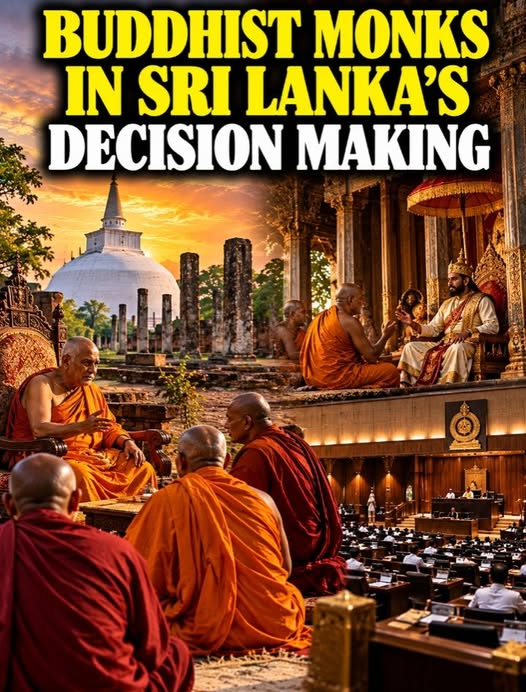
For more than two thousand years, Buddhist monks have played an important role in Sri Lanka’s religious, cultural and political history. Beyond their responsibilities as teachers and spiritual guides, members of the Buddhist Sangha have sometimes advised kings, influenced public opinion, participated in political movements and contributed to debates about the direction of the country.
Their involvement has taken place in many settings, from ancient monasteries and royal courts to modern temples, public meetings and the Parliament of Sri Lanka. Understanding these places reveals how Buddhism and political authority have interacted throughout the island’s history.
1. Anuradhapura: Where Monastic Influence Met Royal Power
Anuradhapura was one of the most important centres of ancient Sri Lankan civilisation. For centuries, its kings supported monasteries, constructed religious monuments and maintained close relationships with Buddhist institutions.
The Mahavihara, Abhayagiri and Jetavana monastic complexes became major centres of religious learning and intellectual life. Monks preserved religious texts, trained students and participated in discussions concerning the moral responsibilities of rulers.
The relationship between kings and the Sangha was not simply ceremonial. Royal patronage helped sustain monastic institutions, while the religious authority of monks contributed to the legitimacy of kingship. Historical scholarship identifies the Anuradhapura period as an important stage in the development of Buddhist monks’ political and advisory roles. <Cite refs={[“turn383953search11″,”turn383953search25”]}/>
2. Polonnaruwa: Monks and the Decisions of Medieval Kings
Polonnaruwa became a major political and religious centre after Anuradhapura declined as the island’s principal royal capital.
During the eleventh to thirteenth centuries, Buddhist institutions maintained connections with rulers who supported religious reforms, monastery administration and the restoration of the Buddhist order. King Parakramabahu I, who ruled in the twelfth century, is particularly associated with efforts to reorganise the Sangha.
Monastic influence during this period was connected with religious discipline, education and the relationship between the Buddhist establishment and the state. Research from the University of Peradeniya identifies the Polonnaruwa period as an important chapter in the political participation of Buddhist monks. <Cite refs={[“turn383953search7”]}/>
3. Kandy: The Royal Court and the Maha Nayaka Theros
Kandy offers another important example of the relationship between religious authority and political leadership. During the Kandyan Kingdom, Buddhist monks and senior religious teachers were involved in maintaining the Buddhist tradition and advising members of the ruling establishment.
The eighteenth century was particularly significant for the revival of higher ordination in Sri Lanka. Under King Kirti Sri Rajasinha, the monk Ven. Weliwita Sri Saranankara Thero played a major role in restoring the Upasampada ordination tradition with assistance from the Siamese Sangha.
The resulting Siam Nikaya became one of the major monastic fraternities in Sri Lanka. The history of this revival demonstrates how religious leaders, royal patronage and international Buddhist connections could combine to influence decisions affecting the island’s religious institutions. <Cite refs={[“turn383953search5″,”turn383953search11”]}/>
4. Kelaniya and Other Temples: Religious Centres of Public Debate
Temples have long served as places where people gather not only for worship but also for education, community discussions and public meetings.
In modern Sri Lanka, some prominent temples have become venues for discussions involving political leaders, senior monks and community representatives. Religious leaders may express views on constitutional questions, education, cultural heritage, public morality and government policy.
However, temples do not possess a single, uniform political position. Different monks and monastic organisations may support different policies or disagree about the proper relationship between religion and government.
Their influence generally comes through religious authority, public communication, community networks and the ability to shape public debate rather than through a universal formal power to make state decisions.
5. Colombo: Parliament and the Modern Political Role of Monks
Colombo became a major centre of modern political decision-making under British colonial rule and after independence in 1948. It is also the location of Sri Lanka’s national Parliament.
The relationship between Buddhist monks and electoral politics became particularly visible during the twentieth century. In 1956, the Eksath Bhikshu Peramuna participated in political mobilisation associated with the election campaign that brought S. W. R. D. Bandaranaike to power.
A further milestone came in 2004, when nine monks entered Parliament following the electoral success of the Jathika Hela Urumaya. Their election demonstrated that some monks had moved beyond influencing political decisions from outside the legislature to participating directly in parliamentary politics. <Cite refs={[“turn383953search10″,”turn383953search24″,”turn383953search1”]}/>
This development also prompted debate about whether elected political office is compatible with the traditional responsibilities of Buddhist monastic life.
6. Presidential Advisory Councils and Government Consultations
Another setting for monastic influence is consultation between religious leaders and the executive branch of government.
Sri Lankan governments have at different times consulted senior monks on matters concerning Buddhism, religious institutions and national heritage. Official parliamentary records, for example, documented the establishment of an advisory council comprising leading Buddhist monks during the administration formed after the 2019 presidential election. <Cite refs={[“turn383953search3”]}/>
Such consultations can give religious leaders an opportunity to express their views on public policy. However, an advisory role is different from possessing legal authority to make a final government decision. The extent of influence depends on the particular council, its mandate and the government’s response.
7. The Maha Sangha and National Political Debates
The Maha Sangha is not a single political organisation. Sri Lanka has several monastic fraternities and many independent religious leaders, each with different institutional responsibilities and perspectives.
The Mahanayaka Theros and other senior monks may be consulted on religious administration, education, the protection of sacred sites and matters affecting the Buddhist community. Some also issue public statements or meet political representatives to express concerns about government policy.
At various points in modern history, monks have mobilised around constitutional change, peace negotiations, national identity and the protection of religious heritage. Academic studies emphasise that Buddhist monks have not acted as a politically uniform group, and their positions have varied according to historical circumstances and personal or institutional commitments. <Cite refs={[“turn383953search2″,”turn383953search5″,”turn383953search24”]}/>
8. How Much Political Authority Do Monks Have?
The distinction between influence and formal authority is essential to understanding this history.
Buddhist monks can advise rulers, participate in public debate, campaign for political causes and, where legally eligible, contest elections. Senior religious organisations may also make decisions concerning their own religious institutions.
Nevertheless, the authority to pass laws, approve national budgets and exercise executive powers belongs to the constitutional institutions and officials designated by Sri Lankan law. Religious advice does not automatically become government policy.
Sri Lanka’s Constitution gives Buddhism the foremost place while also recognising and protecting religious rights. The relationship between this constitutional arrangement, democratic government and religious participation remains an important subject of public discussion.
Conclusion: A Long Relationship Between Religion and Governance
From the monasteries of Anuradhapura and Polonnaruwa to the royal court of Kandy and the Parliament in Colombo, Buddhist monks have occupied different positions in Sri Lanka’s political history.
At times, they acted as teachers and advisers to kings. In other periods, they helped organise religious reform, influenced public opinion or entered electoral politics directly. Their involvement has brought questions of religious responsibility, political representation and constitutional authority into national debate.
The history of Buddhist monks in decision-making is therefore not the story of one institution controlling the state. It is the story of an evolving relationship between religious authority, political leadership and society—a relationship that continues to shape Sri Lanka’s public life.
#SriLankanHistory#BuddhistHeritage#BuddhistMonks#Anuradhapura#Polonnaruwa#Kandy#SriLankanPolitics#MahaSangha#ParliamentOfSriLanka#ReligiousHistory#HeritageLens

Leave a Reply
You must be logged in to post a comment.