
Dilshan Madhuranga
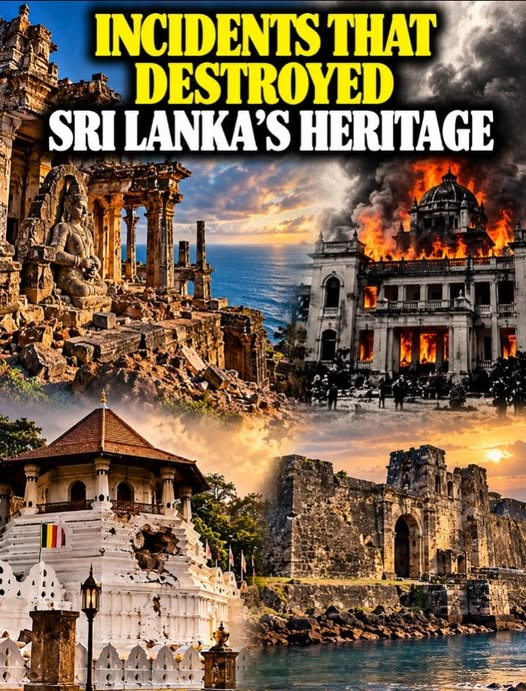
The Incidents That Destroyed Sri Lanka’s Heritage: Forgotten Tragedies That Changed History
Sri Lanka is home to thousands of years of history, from ancient Buddhist monasteries and Hindu temples to colonial forts, historic libraries, churches and traditional buildings. These monuments preserve the memories of kingdoms, religious traditions, artistic achievements and communities that shaped the island’s identity.
However, Sri Lanka’s heritage has suffered serious losses throughout its history. Colonial conquests, religious persecution, armed conflict, deliberate attacks, neglect and uncontrolled development have damaged or destroyed irreplaceable historical treasures. Some sites were rebuilt, while others survive only through archaeological remains, historical records and the memories of the communities connected to them.
The destruction of heritage is not simply the loss of old buildings. It can also mean the disappearance of manuscripts, artistic traditions, religious landmarks and evidence that helps future generations understand their past.
1. The Portuguese Destruction of Koneswaram Temple, Trincomalee — 1622
One of the most significant episodes in Sri Lanka’s religious heritage history occurred at Koneswaram Temple in Trincomalee. Situated on the dramatic Swami Rock overlooking the Indian Ocean, the temple is an ancient Hindu sanctuary dedicated to Lord Shiva.
During the Portuguese colonial period, the temple was destroyed in the seventeenth century. Historical accounts associate the demolition with Portuguese efforts to consolidate colonial authority and promote Catholic Christianity. The temple’s carved stones and architectural materials were subsequently used in the construction of Fort Frederick.
The destruction deprived the region of an important religious and architectural complex. Nevertheless, the temple’s religious significance endured, and a reconstructed sanctuary continues to serve Hindu devotees today.
Koneswaram illustrates how colonial expansion could result in the loss of sacred architecture and the transformation of historic landscapes. <Cite refs={[“turn967603search38″,”turn967603search37”]}/>
2. The Burning of Jaffna Public Library — 1981
Among the most devastating cultural losses in modern Sri Lankan history was the burning of the Jaffna Public Library on the night of 31 May and into 1 June 1981.
The library was a major centre of Tamil literary, historical and scholarly life. Its collection included rare books, manuscripts, newspapers and historical documents that had been gathered over many years.
The fire destroyed a vast portion of this collection, including materials that were extremely difficult or impossible to replace. The loss affected not only the library building but also the preservation of Tamil cultural memory and the history of northern Sri Lanka.
The incident took place amid escalating ethnic and political tensions. The burning became a profound symbol of cultural loss and injustice for many Tamils and further damaged trust between communities.
The library was later rebuilt and reopened, but a new building could not restore every destroyed manuscript or unique historical record. Its history remains an important reminder that protecting libraries and archives is essential to safeguarding a community’s heritage. <Cite refs={[“turn967603search2″,”turn967603search39”]}/>
3. The Destruction of Hindu Temples in Jaffna During Portuguese Rule
During the Portuguese conquest and occupation of the Jaffna region in the seventeenth century, numerous Hindu temples suffered destruction, looting or damage.
Historical and archaeological studies discuss the destruction of the historic Nallur Kandaswamy Temple in the 1620s and the loss of religious buildings and associated objects. Accounts also describe the reuse of stonework from demolished structures in colonial construction.
The original Nallur temple complex did not survive in its former form. The temple that stands today is the result of later rebuilding and subsequent development.
These events form part of a wider history in which colonial military conquest and religious policy affected local places of worship. The evidence for individual sites varies, so specific claims about the fate of each monument should be assessed against historical records and archaeological research.
The surviving temples and reconstructed sanctuaries demonstrate the determination of communities to preserve their religious traditions despite major historical disruptions. <Cite refs={[“turn967603search37″,”turn967603search42”]}/>
4. The Damage to Jaffna Fort During the Civil War
Jaffna Fort is one of Sri Lanka’s most important colonial-era monuments. Originally established by the Portuguese in 1618 and subsequently expanded by the Dutch, the fort preserves evidence of European military architecture and the island’s maritime history.
The fort suffered serious damage during Sri Lanka’s civil war. Fighting and the military use of the surrounding area affected its ramparts and historic buildings, leaving parts of the interior in ruins.
Research published through international cultural heritage organisations documents the extent of the damage and the subsequent efforts to restore the site. Conservation work has involved recording surviving structures, removing dangerous materials and stabilising historic remains.
The restoration of Jaffna Fort demonstrates that heritage conservation can contribute to post-conflict recovery. Protecting such places allows future generations to study the region’s history while creating opportunities for education, tourism and reconciliation. <Cite refs={[“turn967603search36″,”turn967603search1″,”turn967603search4”]}/>
5. The Bombing of the Temple of the Tooth — 1998
The Temple of the Sacred Tooth Relic in Kandy, known as Sri Dalada Maligawa, is among the most important Buddhist religious sites in Sri Lanka. It houses the Sacred Tooth Relic and has been closely associated with the island’s kingship, religious traditions and cultural identity.
On 25 January 1998, the Liberation Tigers of Tamil Eelam (LTTE) carried out a bomb attack on the temple complex. The attack killed people, injured others and caused significant damage to the historic site.
The incident was especially shocking because the temple was both a sacred place of worship and a major symbol of Sri Lankan heritage. Conservation specialists subsequently undertook restoration work to repair the damage and preserve the surviving historic fabric.
The attack demonstrated how cultural landmarks can become targets during armed conflict. It also reinforced the importance of protecting religious sites and the people who visit them, regardless of their faith. <Cite refs={[“turn967603search41″,”turn967603search8”]}/>
6. Damage to Religious Sites During the Civil War
Sri Lanka’s civil war, which lasted from 1983 to 2009, affected communities across the country and caused extensive loss of life, displacement and property destruction. Religious buildings and cultural landmarks belonging to Buddhist, Hindu, Muslim and Christian communities were among the places affected.
Documented incidents include attacks on the Shrine of Our Lady of Madhu, the bombing of churches, attacks on mosques and damage to temples. These events occurred in different circumstances and involved different actors; they should be examined individually rather than treated as a single pattern with one explanation.
The damage to religious heritage often extended beyond physical structures. When a temple, church, kovil or mosque is attacked, communities can lose a place of worship, a gathering space, a repository of collective memory and a symbol of belonging.
Remembering these incidents requires acknowledging the suffering of affected communities without using one tragedy to diminish another. Protecting religious heritage is a responsibility shared across ethnic and religious boundaries. <Cite refs={[“turn967603search8″,”turn967603search41”]}/>
7. Archaeological Destruction, Neglect and Uncontrolled Development
Not every loss of heritage results from war or deliberate attacks. Sri Lanka also faces challenges involving illegal excavation, the removal of antiquities, damage to ancient structures, encroachment and inadequate maintenance.
Ancient monuments can deteriorate when drainage systems fail, vegetation damages masonry, building materials are removed or conservation work is delayed. Construction projects may also threaten archaeological remains if proper surveys and heritage assessments are not conducted.
The destruction of a small archaeological feature can be significant even when it attracts little public attention. An inscription, foundation, burial site or fragment of sculpture may contain evidence that cannot be recovered once it has been removed or destroyed.
Parliamentary records show that the destruction of archaeological monuments and the adequacy of protective measures have been raised as matters requiring government attention. <Cite refs={[“turn967603search5”]}/>
Effective protection requires stronger enforcement of heritage laws, systematic documentation, responsible development planning and cooperation between the Department of Archaeology, local authorities, researchers and communities.
8. Why Destroyed Heritage Matters to Future Generations
Historical monuments are more than tourist attractions. They are physical records of how people lived, worshipped, governed, traded and expressed their artistic abilities.
A destroyed library may contain knowledge unavailable anywhere else. A demolished temple may represent centuries of religious practice. A damaged fort may preserve evidence of military engineering and colonial trade. A neglected archaeological site may contain information that has not yet been studied.
When heritage disappears, historians and archaeologists lose opportunities to reconstruct the past. Communities can also experience a sense of cultural disconnection, particularly when destruction affects places closely associated with their identity.
Preservation does not mean that every old structure must remain unchanged. It means that decisions about restoration, redevelopment and public use should be informed by historical evidence, professional conservation standards and respect for the people connected to the site.
Conclusion: Protecting the Heritage That Remains
From the destruction of Koneswaram Temple during Portuguese rule to the burning of Jaffna Public Library in 1981, the damage to Jaffna Fort during the civil war and the 1998 attack on the Temple of the Tooth, Sri Lanka’s history contains painful examples of cultural heritage being lost or damaged.
These incidents occurred in different historical circumstances and affected different communities. Together, they demonstrate how vulnerable historic places can become during colonial conquest, political conflict and periods of social instability.
Sri Lanka still possesses an extraordinary cultural inheritance, but its survival cannot be taken for granted. Protecting historic buildings, religious sites, manuscripts and archaeological remains requires research, public awareness, responsible government, community participation and respect for the country’s diverse traditions.
Heritage belongs not only to those who created it in the past, but also to the generations who will inherit it in the future. Once unique evidence of history has been destroyed, rebuilding a monument cannot always restore what has disappeared.
Preserving Sri Lanka’s heritage is therefore not simply about saving old buildings. It is about protecting the memories, knowledge and cultural identities that make the island’s history meaningful.
#SriLankanHeritage#SriLankanHistory#JaffnaLibrary#KoneswaramTemple#JaffnaFort#TempleOfTheTooth#CulturalHeritage#Archaeology#HeritageConservation#ColonialHistory#HeritageLens
See less

Leave a Reply
You must be logged in to post a comment.