
Dilshan Madhuranga
Suggested for you ·h͏5͏1͏ ·
Why Did Some Kandyan Chiefs Help the British Capture the Last King of Kandy?
The fall of the Kandyan Kingdom in 1815 remains one of the most significant turning points in Sri Lankan history. For centuries, the Kingdom of Kandy had resisted Portuguese, Dutch, and British attempts to establish control over the island’s central highlands. Yet, in February 1815, British troops entered Kandy, and the kingdom’s last monarch, Sri Vikrama Rajasinha, was captured. What made this event particularly remarkable was that the British did not succeed through military strength alone. Political rivalries, dissatisfaction among powerful nobles, and carefully planned British diplomacy played major roles in the kingdom’s collapse.
Sri Vikrama Rajasinha, who ruled from 1798 to 1815, belonged to the Nayakkar dynasty of South Indian origin. His reign was marked by ambitious building projects, including the development of Kandy’s lake and improvements to the royal capital. However, his relationship with several powerful Kandyan chiefs deteriorated over time. The king depended on the support of the aristocracy to govern the kingdom, while the chiefs possessed considerable influence over regional administration, land, labour, and military affairs. As mutual distrust increased, the political unity that had helped Kandy resist foreign powers began to weaken.
One of the central figures in this conflict was Ehelepola Nilame, a powerful Kandyan noble who had served as a leading minister. His relationship with the king deteriorated amid political rivalry and disputes over authority. When a rebellion associated with Ehelepola broke out in Sabaragamuwa in 1814, it was suppressed, and Ehelepola fled to British-controlled territory. From there, he became an important source of information and political support for the British campaign against the king.
The conflict took a tragic turn when the king ordered severe punishment against members of Ehelepola’s family after Ehelepola failed to return and submit to royal authority. Accounts of the execution of his wife and children became one of the most notorious episodes associated with Sri Vikrama Rajasinha’s reign. The event deepened hostility towards the king and provided his opponents with a powerful reason to support his removal. Although the details of historical accounts should be examined critically, the episode had a lasting influence on how the king’s rule was remembered. <Cite refs={[“turn821353search2″,”turn821353search9”]}/>
However, personal revenge alone cannot explain the actions of the Kandyan chiefs. The kingdom’s political structure was built around powerful aristocratic families whose authority depended on their positions, privileges, and relationships with the monarch. When a king threatened their influence or acted against their interests, some nobles could see cooperation with an external power as a way to protect themselves or reshape the political order. Their decisions were influenced by individual ambitions, rivalries, fears, and calculations about the future of the kingdom.
Another factor was dissatisfaction with obligations imposed on the population. Historical scholarship has examined the role of compulsory labour, known as rajakariya, and other demands placed on subjects during the reign. The burden of labour obligations and the relationship between the monarchy and the people may have contributed to discontent in parts of Kandyan society. Nevertheless, the extent of popular opposition is debated, and it would be inaccurate to assume that all ordinary people or all Kandyan chiefs wanted the king removed. <Cite refs={[“turn821353search2″,”turn821353search27”]}/>
The British, meanwhile, had been seeking control over the Kandyan Kingdom for many years. Their attempt to capture Kandy in 1803 had failed, demonstrating the difficulties of invading the mountainous interior. By 1815, British officials had developed a more detailed understanding of Kandyan politics. John D’Oyly, a British official who had acquired extensive knowledge of the Sinhala language and local political affairs, played an important role in communication between the British administration and Kandyan nobles. British diplomacy exploited divisions within the kingdom and helped secure cooperation from influential chiefs.
When British forces advanced into the Kandyan territories in early 1815, they encountered much less organised resistance than they had during the failed invasion of 1803. Some chiefs assisted the British, while others refrained from defending the king. Their cooperation and the absence of a unified military response made it much easier for the British to occupy the capital. The campaign therefore succeeded through a combination of military pressure, political intelligence, internal divisions, and local cooperation. <Cite refs={[“turn821353search5″,”turn821353search7”]}/>
Sri Vikrama Rajasinha fled Kandy as British forces approached. He was captured on 18 February 1815 near Medamahanuwara, with the assistance of people who helped the British locate him. His capture ended the rule of the last king of Kandy, although the formal transfer of sovereignty followed through the Kandyan Convention in March. The king and his family were subsequently exiled to southern India, where he died in 1832.
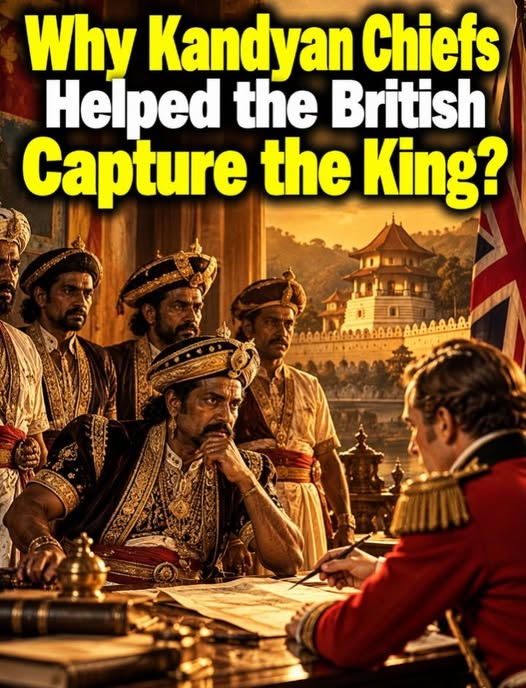
On 2 March 1815, the Kandyan Convention was signed between the British governor, Sir Robert Brownrigg, and leading Kandyan chiefs. The agreement formally transferred sovereignty over the Kandyan Kingdom to the British Crown and ended the island’s last independent monarchy. In return, the British made commitments concerning the protection of Buddhism, its institutions, and established customs. The agreement also allowed some traditional administrative structures and privileges of the chiefs to continue under British authority. <Cite refs={[“turn821353search0″,”turn821353search7”]}/>
For some nobles, the agreement may initially have appeared to offer a way to remove an unpopular monarch while preserving their own positions. Yet the consequences were far-reaching. The chiefs had helped dismantle the monarchy, but they had not secured an independent Kandyan state under their own leadership. Sovereignty passed to the British Empire, which gradually consolidated control over the island’s administration and political institutions.
The events that followed demonstrated the limits of the arrangement. In 1818, a major rebellion erupted in the Kandyan provinces against British rule. Several people who had previously supported the removal of Sri Vikrama Rajasinha came to oppose the colonial administration. Monarawila Keppetipola Nilame, who had initially served the British, became one of the best-known leaders of the rebellion before being captured and executed. His changing role illustrates how the political calculations of 1815 did not necessarily translate into lasting acceptance of British rule.
The question of whether the Kandyan chiefs should be remembered as traitors, political strategists, or men caught in a struggle for power remains a subject of historical interpretation. Some acted out of personal hostility towards the king; others sought to preserve their privileges or believed that cooperation with Britain would protect the kingdom’s traditions. British officials, for their part, pursued the strategic objective of bringing the entire island under imperial control. These motivations overlapped, but they were not identical.
It is also important to distinguish the decisions of the ruling elite from the views of the entire Kandyan population. The chiefs who negotiated with the British did not necessarily represent every villager, soldier, monk, or regional leader. Many people had little direct influence over the negotiations that determined their political future. The loss of sovereignty was therefore not simply the result of one group betraying another; it emerged from a complex interaction of internal divisions and imperial ambition.
Ultimately, the capture of Sri Vikrama Rajasinha in 1815 demonstrates how a kingdom can fall when internal political divisions coincide with the ambitions of a powerful foreign state. The British benefited from the grievances of Kandyan nobles, while some chiefs underestimated the long-term consequences of transferring sovereignty to a colonial empire. The removal of the king settled one political conflict, but it marked the beginning of a new era of British rule.
The story remains an important reminder that political alliances formed to defeat a common opponent can produce consequences far beyond their original purpose. The Kandyan chiefs helped make the king’s capture possible, but the outcome was not the restoration of an independent kingdom. It was the end of the Kandyan monarchy and the consolidation of British control over Sri Lanka.
Sources and further reading: Department of National Archives of Sri Lanka, “1815 Convention”; The Buddha’s Tooth: Western Tales of a Sri Lankan Relic, University of Chicago Press; Lee C. Godden and Niranjan Casinader, “The Kandyan Convention 1815: Consolidating the British Empire in Colonial Ceylon,” Comparative Legal History (2015); and The Final Conquest, The Sunday Times, Sri Lanka.
#KandyanKingdom#SriLankanHistory#SriVikramaRajasinha#KandyanConvention#EhelepolaNilame#JohnDOyly#BritishColonialHistory#KandyanHistory #1815 #ForgottenHistory#HeritageLens

Leave a Reply
You must be logged in to post a comment.