
France in Turmoil: Rising Public Anger, €3.6 Trillion in Debt and a Growing Crisis of Confidence
Veluppillai Thangavelu
France, one of Europe’s most influential political and economic powers, is experiencing a wave of public unrest that has raised serious questions about the country’s economic stability, political leadership and social cohesion.
What began as student demonstrations over deteriorating educational facilities, teacher shortages and inadequate public funding has reportedly developed into a much broader movement involving workers, trade unions, teachers and ordinary citizens.
Recent accounts of demonstrations in major French cities, including Paris, Marseille, Lyon and Toulouse, have raised concerns about violent confrontations, property damage, attacks on commercial establishments and arrests. The precise scale of the latest incidents, however, requires independent verification.
The unrest threatens to create an additional economic burden for a country already struggling with substantial public debt, fiscal pressures and uncertainty over future economic growth.
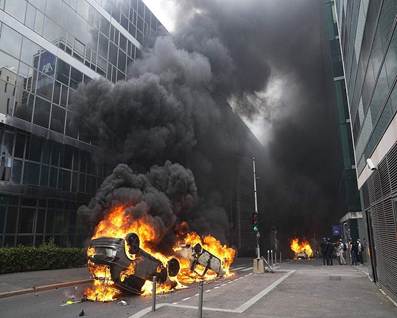
France’s difficulties are particularly significant because similar grievances concerning living costs, housing, employment and public services are being expressed elsewhere in Europe.
The central question is no longer simply whether the French government can bring demonstrations under control. It is whether Europe’s established political and economic institutions can adequately respond to the growing expectations and frustrations of their populations.
The origins of the reported unrest lie partly in concerns about conditions within France’s education system. Students and teachers have raised questions about overcrowded classrooms, shortages of qualified teachers, deteriorating school buildings and unequal access to educational opportunities.
These concerns are particularly significant in disadvantaged communities, where educational inequalities can reinforce existing social and economic divisions.
However, dissatisfaction extends well beyond education.
Rising living costs, housing affordability, wage stagnation, employment insecurity and pressure on public services have become important sources of frustration.
For many young Europeans, the traditional expectation that education and hard work will lead to economic security is increasingly being questioned.
Will university qualifications guarantee stable employment? Will young workers be able to purchase homes? Can the next generation expect a higher standard of living than its parents?
These concerns reflect a growing sense of uncertainty about the future.
France has experienced similar periods of social unrest before. The Yellow Vest movement, which emerged in 2018 following opposition to fuel taxation, eventually developed into a wider protest against economic inequality, declining purchasing power and perceived political neglect.
The grievances expressed during that movement remain relevant to contemporary debates about economic fairness and political representation.
France’s long history of public mobilisation also illustrates how dissatisfaction originating within one sector of society can develop into a broader challenge to government policy.
One of the most troubling possible consequences of prolonged civil unrest is the destruction of public and private property.
When violent groups target government buildings, commercial establishments, vehicles or transport infrastructure, the resulting economic damage extends far beyond the immediate cost of repairs.
A damaged commercial establishment may face substantial reconstruction expenses. Employees may temporarily lose their income, suppliers may experience reduced demand and surrounding businesses may suffer from declining commercial activity.
Insurance companies may be required to meet compensation claims, while local governments must allocate resources to repair damaged public facilities.
Disruption of commercial activity can also reduce tax revenue.
France is one of the world’s leading tourist destinations, and prolonged instability may discourage visitors, particularly if demonstrations affect transport networks, shopping districts and major tourist attractions.
Although substantial losses have been attributed to recent unrest, the full economic cost must be established through reliable assessments. Direct property damage, lost sales and business interruption are different categories of loss and should not be combined without accounting for possible overlap.
Nevertheless, the broader economic implications of extensive destruction are serious.
Money that might otherwise have supported investment, business expansion or public services must instead be directed towards reconstruction and recovery.
This creates a painful contradiction.
Many demonstrators demand greater public investment in education, healthcare and social welfare. Yet destruction occurring during periods of unrest can place additional pressure on the very financial resources required to address those demands.
At the same time, it would be misleading to hold peaceful demonstrators collectively responsible for the actions of violent groups.
The right to peaceful protest remains fundamental to democracy, while the protection of public safety and property remains an essential responsibility of the state.
France’s economic difficulties become more apparent when examined alongside the country’s public debt.
According to figures published by France’s national statistics institute, INSEE, general government debt reached approximately €3.5955 trillion at the end of the second quarter of 2026.
This represented approximately 119% of the country’s gross domestic product.
The figure is particularly important because it demonstrates the scale of France’s existing financial obligations.
However, a distinction must be made between public debt and external debt.
The €3.6 trillion figure represents France’s total general government debt, including liabilities associated with central government, local authorities and social security institutions. It does not refer exclusively to money borrowed from foreign creditors.
France’s government must continue financing education, healthcare, pensions, social security, infrastructure and national defence while meeting its debt-servicing obligations.
As public debt increases, the government becomes more sensitive to borrowing costs and changes in financial market confidence.
Higher interest rates can make refinancing existing obligations more expensive and reduce the fiscal flexibility available for new spending.
This creates a difficult political dilemma.
The government is under pressure to control expenditure and reduce fiscal deficits. Meanwhile, citizens are demanding increased public investment, improved services, higher wages and stronger social protection.
Both concerns are legitimate, but reconciling them requires difficult choices.
Reducing public expenditure too rapidly may weaken economic activity and increase social dissatisfaction. Continuing to expand expenditure without sustainable financing may increase borrowing requirements and create additional fiscal risks.
The challenge is therefore not simply to reduce public debt, but to establish a credible balance between fiscal sustainability and the protection of essential public services.
France’s economic future will depend partly on its ability to promote growth, improve productivity, maintain investor confidence and implement reforms that command sufficient public support.
The relationship between social unrest and economic performance deserves particular attention.
Public dissatisfaction often emerges when households experience financial pressure, declining purchasing power or reduced access to essential services.
Demonstrations may then disrupt transport, retail activity, tourism and other sectors of the economy.
When protests are accompanied by extensive property damage, the financial consequences become more severe.
Business closures can reduce employment opportunities, while reconstruction costs divert resources from other productive activities.
If economic disruption continues, weaker business activity may affect government revenue and make existing fiscal challenges more difficult to manage.
This does not mean that peaceful demonstrations necessarily damage an economy more than the policies they challenge.
Indeed, protest movements have historically contributed to improvements in labour rights, political representation and social welfare.
The important distinction is between democratic pressure for reform and destructive violence.
A sustainable solution requires governments to address legitimate grievances while ensuring that demonstrations remain peaceful and public institutions are protected.
France’s experience must also be understood within a wider European context.
Across the continent, governments are confronting similar structural pressures.
The cost of housing has increased substantially in many urban areas. Younger workers face difficulties securing affordable accommodation, while households struggle with essential expenses.
In several countries, wage growth has not consistently matched increases in living costs.
European governments are also managing the financial consequences of ageing populations, growing pension obligations, energy insecurity and increased defence requirements.
These pressures have intensified debates over the future of public expenditure.
In Italy, labour organisations and political movements have raised concerns about wages, employment conditions, public services and government spending priorities.
Under Prime Minister Giorgia Meloni, debates over economic policy, public investment and defence expenditure have become part of the country’s wider political discussion.
In Portugal, housing affordability has emerged as a major social concern, particularly in urban centres where rising rents have placed pressure on residents.
Germany has experienced debates over economic competitiveness, public investment, living costs and the future of its industrial economy.
Belgium has also witnessed demonstrations concerning education and public spending.
Denmark faces its own economic and social policy debates, although available evidence does not establish that it has experienced a nationwide protest movement comparable in scale to France’s reported unrest.
These developments should not be interpreted as a single coordinated European revolution.
Each country has its own political institutions, economic conditions and immediate causes of dissatisfaction.
Nevertheless, they reveal a common underlying concern: whether Europe’s economic systems are continuing to provide security, opportunity and a reasonable standard of living for ordinary citizens.
One of the most important issues emerging from these developments is the future of the European welfare state.
Following the Second World War, many Western European countries developed extensive systems of public healthcare, education, pensions, unemployment assistance and labour protection.
These arrangements contributed significantly to improvements in living standards and social stability.
They also helped establish the expectation that governments should provide a basic level of economic security.
However, the economic environment has changed considerably.
European populations are ageing, placing greater pressure on pension and healthcare systems.
Economic growth has slowed in parts of the continent, while international competition has intensified.
Governments must also respond to technological change, climate-related investment needs, energy security and a changing international security environment.
These demands require substantial financial resources.
At the same time, taxpayers and households expect governments to maintain the public services on which they depend.
The result is a growing tension between the financial sustainability of welfare systems and the political expectations surrounding them.
The challenge is not necessarily the disappearance of the welfare state, but its adaptation to new demographic, economic and geopolitical realities.
Governments that fail to explain these choices clearly, or distribute their costs fairly, risk losing public confidence.
Another important dimension of the present European debate concerns defence expenditure.
Russia’s invasion of Ukraine and broader concerns about European security have encouraged governments to reconsider military preparedness and defence investment.
Supporters of increased defence spending argue that national security is a fundamental responsibility of government and that Europe must strengthen its capacity to respond to external threats.
Critics question whether additional military commitments could place pressure on education, healthcare, housing and other domestic priorities.
The issue is particularly sensitive when households are already experiencing financial hardship.
However, the relationship between defence and welfare spending is not always a simple choice between one and the other.
Government budgets involve multiple revenue sources, long-term commitments and competing national priorities.
Nevertheless, the political significance of the debate is clear.
Citizens increasingly want to know how public money is being allocated, who benefits from government decisions and whether national economic priorities reflect their everyday needs.
France has a long history of popular movements that have influenced political developments far beyond its borders.
The French Revolution of 1789 fundamentally transformed the country’s political institutions and helped spread ideas concerning citizenship, equality and popular sovereignty.
In May 1968, student demonstrations developed into a much wider movement involving millions of workers and extensive strikes.
Although the political circumstances were very different, those events demonstrated the capacity of student activism to become a catalyst for broader social change.
The Yellow Vest protests of 2018 provided another example of how economic grievances can develop into sustained opposition to government policy.
Contemporary unrest may share certain characteristics with these earlier movements, particularly the involvement of students and the convergence of different social grievances.
However, historical parallels must be treated carefully.
A large protest movement does not automatically constitute a revolution.
Revolution generally involves fundamental changes to political authority, institutions or social structures.
France continues to possess established democratic institutions, including an elected parliament, an independent judiciary and mechanisms for political competition.
The present political tensions may therefore produce policy reforms, electoral consequences or changes in political leadership without necessarily resulting in revolutionary transformation.
France’s next presidential election, scheduled for 2027, provides an important political backdrop.
Economic dissatisfaction, public debt, immigration, national security and the quality of public services are likely to feature prominently in the election campaign.
Public unrest may strengthen political movements that present themselves as alternatives to established leadership.
Left-wing parties are likely to emphasise economic inequality, public investment, wages and social protection.
Right-wing parties may place greater emphasis on public order, immigration, national identity and government effectiveness.
However, public dissatisfaction does not necessarily benefit one political movement.
Different voters may interpret the same events in different ways.
Some may blame government policies for creating the conditions that produced the protests.
Others may become increasingly concerned about public disorder, property destruction and the economic consequences of prolonged demonstrations.
The eventual political outcome will depend on how the government responds, whether protest movements maintain public support and whether opposition parties can offer credible alternatives.
France’s economic position is challenging, but it is important to distinguish fiscal pressure from imminent financial collapse.
A public debt ratio of approximately 119% of GDP is substantial, yet the sustainability of government debt depends on several factors beyond its total size.
These include economic growth, borrowing costs, government revenue, the maturity of outstanding debt and investor confidence.
France also benefits from being a major economy within the euro area, supported by developed financial markets and established European monetary institutions.
Nevertheless, persistently high fiscal deficits, weak economic growth and rising borrowing costs could reduce the government’s financial flexibility.
Prolonged political instability may make fiscal reforms more difficult to implement.
The destruction of property and disruption of commercial activity can add to these challenges, although the direct financial cost of unrest would remain much smaller than France’s overall public debt.
The greater long-term risk may lie in the interaction between economic stagnation, political fragmentation and declining public trust.
If governments cannot build sufficient public support for necessary reforms, economic difficulties may become increasingly difficult to resolve.
Several possible political outcomes can be identified.
The French government may introduce further concessions concerning education, public services and social spending.
Such measures could reduce immediate tensions, particularly if student organisations and trade unions consider their principal demands to have been addressed.
However, deeper economic grievances may remain unresolved.
A second possibility is that demonstrations continue intermittently, with periods of relative calm followed by renewed mobilisation.
This pattern has occurred during earlier French protest movements.
A third possibility is that unrest produces significant electoral consequences, reshaping political alliances and influencing the outcome of the 2027 presidential election.
There is also a risk that continued confrontation between protesters and security forces could intensify political polarisation.
None of these outcomes is inevitable.
Much will depend on the government’s willingness to negotiate, the ability of protest movements to maintain broad public support and the economic conditions facing French households in the months ahead.
The tensions in France highlight a wider challenge confronting modern democracy.
Economic development alone does not guarantee political stability.
A country may possess advanced infrastructure, major industries, strong financial institutions and considerable international influence while sections of its population experience insecurity and frustration.
Citizens judge economic success not only through national statistics but also through their ability to afford housing, obtain healthcare, secure employment and provide opportunities for their children.
When the benefits of economic growth are perceived to be unevenly distributed, confidence in political institutions may weaken.
Governments must therefore do more than achieve favourable economic indicators.
They must demonstrate that economic policies contribute to improvements in people’s everyday lives.
At the same time, citizens and political movements must recognise that the destruction of public infrastructure and private property ultimately imposes costs on society.
Peaceful democratic protest can encourage reform and strengthen accountability.
Violence and destruction, by contrast, can undermine public confidence, damage economic activity and divert attention from legitimate demands.
France today stands at a difficult political and economic crossroads.
With approximately €3.6 trillion in public debt, significant pressure on government finances and growing public dissatisfaction, the country faces challenges that cannot be resolved through short-term political measures alone.
Property destruction and disruption of commercial activity, wherever they occur, add another layer of economic pressure.
Yet the deeper causes of public dissatisfaction extend far beyond immediate demonstrations.
They concern the affordability of everyday life, access to quality education, employment opportunities, housing security and the future of social protection.
Similar questions are being raised across Europe.
The central challenge for European governments is to reconcile fiscal responsibility with social justice, economic competitiveness with public welfare, and national security with the needs of ordinary citizens.
The French experience demonstrates that political stability cannot be maintained through economic statistics alone.
It requires public confidence, effective institutions and a widely shared belief that future generations will enjoy meaningful opportunities for advancement.
The destruction of public property cannot provide a solution to economic hardship. Equally, ignoring the legitimate concerns of citizens cannot guarantee lasting stability.
The way forward must involve democratic dialogue, responsible economic management and reforms that address the underlying sources of dissatisfaction.
The question emerging from France is not merely whether a government can survive a period of public unrest. It is whether Europe’s political and economic institutions can continue to command the confidence of the people they are intended to serve.
France’s response to this challenge may help determine not only its own political future, but also the direction of Europe’s broader debate over democracy, economic security and social justice.

Leave a Reply
You must be logged in to post a comment.