
Sri Lankan Buddhism: Moving Away from the Path Shown by the Buddha!
By Veluppillai Thangavelu
The Buddha was one of the greatest rational thinkers to emerge from India. He encouraged people to think about why they should believe something rather than simply what they should believe. He did not make the existence of an omnipotent creator God the foundation of his teachings. If such a creator God exists, the question arises: who created that God? This question can lead to an endless debate.
The Buddha also rejected the idea that an eternal, unchanging soul exists within a human being. A central feature of his teaching is that human beings and the world are constantly changing. He did not simply accept the religious beliefs of ancient India concerning karma and rebirth; he reinterpreted them within his own distinctive philosophy. Rather than encouraging people to depend on divine grace or rituals to overcome suffering, he emphasised the importance of understanding and transforming their own minds and behaviour.
At the heart of the Buddha’s teachings are the Four Noble Truths: suffering exists in life; desire and attachment are the causes of suffering; suffering can cease by eliminating desire and attachment; and the way to achieve this is the Noble Eightfold Path. This ethical teaching, which explained how human beings should and should not live, emphasised personal morality and clarity of thought.
The Buddha taught people how to live, what actions to avoid, and how to free themselves from suffering. He showed them a path of controlling desire, abandoning hatred and anger, and living with wisdom and virtue. Yet, when we observe some of the practices carried out today in Sri Lanka in the name of Buddhism, a question arises: Buddhism came to free people from attachment, but what kinds of attachments has it itself become entangled in?
This is not a criticism of the fundamental teachings of Buddhism. Rather, it is a question that highlights the contradictions between the ethical principles taught by the Buddha and the practices of some who claim to follow them.
As mentioned earlier, the Four Noble Truths taught by the Buddha form the foundation of Buddhism.
The First Truth — Dukkha (Suffering): Suffering exists in human life. Birth, ageing, illness, death, and the inability to obtain what one desires can all cause suffering.
The Second Truth — Samudaya (The Origin of Suffering): Desire and attachment are the causes of suffering.
The Third Truth — Nirodha (The Cessation of Suffering): By eliminating desire and attachment, it is possible to become free from suffering.
The Fourth Truth — Magga (The Path Leading to the Cessation of Suffering): The way to overcome suffering is the Noble Eightfold Path. Its eight components are Right View, Right Intention, Right Speech, Right Action, Right Livelihood, Right Effort, Right Mindfulness, and Right Concentration.
These principles are not intended only for those who have renounced worldly life. People living ordinary household lives can follow them too. Living honestly, avoiding harm to others, and controlling desire and anger are ethical principles that apply to all human beings.
After the Buddha’s death, several branches of Buddhism emerged. Among the most important are Theravada and Mahayana. Theravada means the teaching or tradition of the elders, while Mahayana means the Great Vehicle. Over time, the cultures and local beliefs of different countries influenced Buddhist practices. In Sri Lanka, too, Buddhism developed distinctive social, political, and cultural forms.
At many Buddhist temples in Sri Lanka, rituals are performed that include worship at the Bodhi tree, the chanting of pirith (protective Buddhist verses), the giving of blessings, and the tying of sacred threads. In some places, beliefs and practices involving exorcism and black magic are also found.
These rituals may sometimes provide people with emotional comfort. But can they replace the ethical conduct and mental discipline emphasised by the Buddha? If someone commits an injustice against another person and then visits a temple to have pirith chanted or receive a blessing, does that erase the wrongdoing? Is it not necessary to return money taken through deception and apologise to those who have been harmed?
Rituals cannot replace conscience. The true ethical path lies in recognising one’s wrongdoing and correcting it.
The lifestyles of Buddhist monks in Sri Lanka also raise questions. Renunciation means reducing worldly attachments and giving priority to spiritual practice and ethical living. Yet criticisms have emerged that some monks engage in commercial activities, focus on collecting money and accumulating property, and travel in luxurious vehicles. Some also exert influence within political power structures and interfere in government administration.
The question is not whether it is wrong for a monk to travel in a vehicle. What matters is the purpose around which his life is organised. Using resources for public welfare, such as education, healthcare, and the advancement of the poor, is commendable. But how can cultivating personal influence and luxury in the name of renunciation be reconciled with the Buddha’s teaching of non-attachment?
Not all Buddhist monks are like this. There are monks who dedicate themselves to education, social service, and charitable work. Their service deserves respect. At the same time, it is necessary to criticise conduct that brings the institution of monastic life into disrepute.
In Sri Lanka, Buddhism and politics are closely intertwined. There is nothing inherently wrong with Buddhist religious leaders expressing views on public policy. However, we must ask whether their views are guided by ethical principles or by political interests.
A monk should help reduce hatred in society and promote harmony among ethnic communities. He should also point out wrongdoing by those in power. But if inflammatory speeches delivered in the name of religion foster hostility among people, how can such conduct be reconciled with the Buddha’s teaching of compassion?
The fact that Buddhism is the religion of the majority does not give anyone the right to exercise political power without scrutiny. Respecting the rights and freedom of worship of people belonging to other religions is an essential expression of genuine ethical conduct.
Buddha statues are being erected in many places across Sri Lanka. They may serve as religious symbols and expressions of artistic heritage. But does erecting statues alone ensure that the Buddha’s teachings take root in people’s lives?
A city may have an enormous Buddha statue. Yet corruption may continue in that same city; the poor may be neglected; and the vulnerable may be oppressed. If so, where is the ethical message that the statue is supposed to remind people of?
Rather than making statues rise higher, it is more important to make the truth and compassion taught by the Buddha stand tall in human conduct. Even a portion of the money spent on erecting statues could be used for the education of poor children, the treatment of patients, and the care of the elderly.
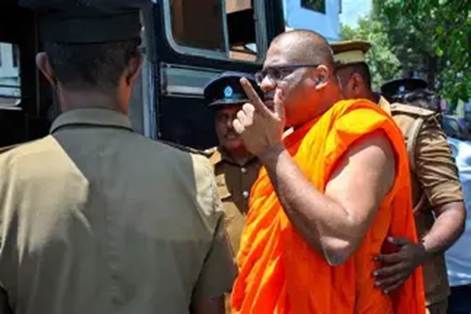
Recent incidents have intensified questions about the conduct of Buddhist monks in Sri Lanka. Allegations and court proceedings involving Galagoda Aththe Gnanasara Thero, including allegations relating to driving under the influence of alcohol, have appeared in the news in the past.
Gnanasara Thero, the general secretary of the Bodu Bala Sena organisation, has reportedly been returned to prison to serve the remaining portion of a six-year sentence imposed in a contempt-of-court case. In protest against this, demonstrations have been held in Colombo under the leadership of Balangoda Kassapa Thero. Meanwhile, the chief prelate of the Asgiriya Buddhist Chapter has appealed to President Anura Kumara Dissanayake to grant Gnanasara Thero a pardon and release him.
In this context, a media outlet in southern Sri Lanka has published information about the allegations and legal proceedings involving him. According to that report, more than twenty allegations have been recorded against Galagoda Aththe Gnanasara Thero.
There have also been reports that Buddhist monks returning to Sri Lanka from Thailand were arrested on suspicion of drug trafficking. Investigations reportedly indicated that a monk named Amith Ananda had led the alleged operation.
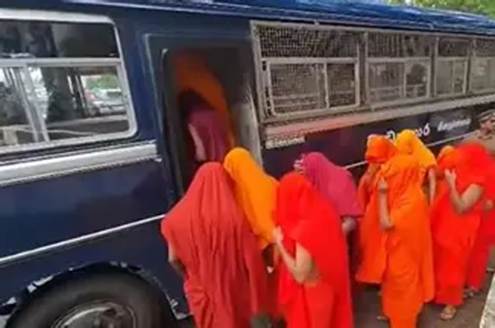
The Buddha taught not merely that people should preach morality to others, but that they should practise self-restraint, discipline, and non-harm in their own lives. Being a monk does not place anyone above the law or ethical standards. Whatever the identity of a person facing allegations, the allegations must be investigated fairly, the rights of those affected must be protected, and legal action must be taken if guilt is established.
Another monk, Pallegama Hemarathana, was reportedly arrested on allegations of sexual misconduct involving a 16-year-old girl and was subsequently released on bail. There is no question that these allegations must be established in court. Nevertheless, when such allegations are made against religious leaders who are expected to teach morality, society cannot avoid asking how the respect and authority conferred by religion are being used.
Such allegations raise questions about the effectiveness of ethical discipline and oversight within Buddhist monastic institutions. The law that applies to an ordinary citizen must also apply to a monk. Religious robes or status cannot confer immunity from the law. Rather than concealing the truth to protect the reputation of a religion, there must be proper investigations and the pursuit of justice.
The problem facing Sri Lankan Buddhism is not that all monks are guilty of wrongdoing. The real question is whether a gap has developed between the conduct of some monks and the fundamental ethical principles of Buddhism.
The Buddha taught people to control desire. But what happens when wealth and influence are pursued in the name of religion? He taught people to overcome hatred. But what happens when hate speech is delivered in the name of religion? He emphasised right livelihood. But what happens when religious identity is used to facilitate unlawful activities?
These are questions that Buddhist institutions must ask themselves as part of a process of self-examination. The true strength of a religion does not lie in the number of temples, the size of its statues, or its closeness to political leaders. It lies in the extent to which it fosters honesty, compassion, and justice in people’s lives.
Temples should function not merely as centres for rituals but also as institutions that provide ethical education. Ethical training and accountability for monks should be strengthened. There should be transparency in the use of money collected in the name of religion. When allegations arise, institutions should cooperate with proper investigations rather than conceal them.
Everyone who claims to follow Buddhism should ask themselves a question: Does identifying as a Buddhist automatically make someone a good person? Or is a person good because honesty and compassion are reflected in their words and actions?
This question applies not only to Buddhists but to followers of all religions. It is unfair to condemn everyone who follows a religion because of the misconduct of some of its adherents. At the same time, it is wrong to hesitate to criticise wrongdoing committed in the name of religion.
The Buddha guided people to recognise suffering, investigate its causes, train their minds, and live ethically. Temples may be built, statues erected, and festivals organised in his name. But unless honesty, compassion, and non-attachment grow, the contradiction between outward appearances and inner life will continue.
It is easy to erect a tall statue of the Buddha. It is much harder to uphold the ethical principles he taught in our own lives.
Rather than seeking power in the Buddha’s name, it is more important to follow the truth he taught. Rather than seeking blessings, it is more important to live without doing wrong. Rather than performing rituals, it is more important to avoid harming others.
Sri Lankan Buddhism must rediscover this fundamental truth. Doing so would benefit both Buddhism and Sri Lankan society.
Finally, one question remains: If the Buddha were alive in Sri Lanka today, would he accept everything done in his name? Or would he once again remind people of the path he showed them to free themselves from suffering?

Leave a Reply
You must be logged in to post a comment.